
Dispute grows over plans to remove old cemetery remains
Trending
STEUBENVILLE -- A Jefferson County businessman is one of at least five people who filed written objections to allowing Woda Cooper Companies to disinter remains from the old Catholic cemetery at the top of Washington Street hill in Steubenville.
Those letters asked Probate Judge Frank Noble Jr. to "require a complete, transparent, scientifically sound, and dignified process before authorizing the disturbance or permanent removal of any human remains," citing the cemetery's historical significance.
The cemetery, alternatively known as "Jacksonville," "Leicy's Field" and "the Market Street Addition Cemetery," was initially established as part of the relocation and consolidation of cemeteries from downtown Steubenville. From 1878-1880, the watchman's reports submitted to the Steubenville Weekly Herald routinely reported up to five burials a month, leading local historians to project as many as 50 members of the Catholic community per year were laid to rest there. They also point out that annual Decoration Day observances honoring Jefferson County veterans routinely stopped at the old Catholic cemetery so a band could play appropriate music while the procession paused for prayers to honor those who'd served.
Resident Gary Smith pointed out Ohio law recognizes cemeteries as legally protected places of burial, insisting that protection "does not disappear merely because markers were lost, vegetation grew over the site, cemetery records became incomplete or later owners ceased maintaining the grounds."
"The Supreme Court of Ohio has similarly described cemeteries as protected resting places rather than ordinary real estate," he added. "Ohio's statutory framework reflects a public policy that burial grounds are entitled to continued respect even they are old, abandoned or no longer accepting interments."
Another letter writer, Flora VerStraten-Merrin, local historian and president of the Jefferson County Chapter of the Ohio Genealogical Society, said the cemetery "stands as a piece of our early pioneer history, an outdoor history book, a genealogical goldmine."
"It's sad that the vintage tombstones and...pioneer remains were covered in topsoil at some point, instead of being reinterred," she said. "This was once a vital Catholic cemetery with military recognition services and some of the first Catholic families to settle in the city, many coming from Irish roots."
VerStraten-Merrin said the cemetery "holds the physical remains and stories of early settlers, preserves unique art and craftsmanship on old headstones."
"They all deserve the respect of an honorable reinterment or to be left where they are in peace with a fence (around the cemetery grounds), a history of the cemetery, and a deed acknowledgement of no future use for this sacred ground and allow it to remain a greenspace for those buried there to rest in peace, just as it has been since 1883."
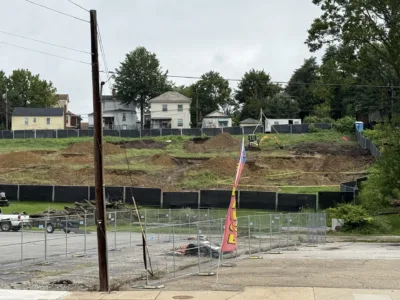
The current owner, Woda Cooper Companies, wants to build affordable senior housing at the site. Construction crews were prepping the site for construction when they spotted a handful of grave markers in the soil. By law, all construction activities were halted and an archaeological consultant was hired to determine if the site still contained human remains.
Initially skeptical that the remains weren't reinterred when the new cemetery, Mt. Calvary, opened in 1883, Woda admitted in its state-required "Archaeological Treatment Plan for the Recovery of Human Remains and Associated Burial Objects" that researchers had located remains of at least 12 individuals within days of arriving on site.
The consultant, ASC Group, did not find any markers or remains in the 150-plus truckloads of dirt removed from the site before dirt-moving was halted by the discovery of the six surviving markers, but it's not known if they tested the four truckloads known to have been dumped at four Jefferson County sites.
Woda's plan mapped out a strategy for disinterring the remains of what ASC called "John Does" found in the cemetery and then reinterring them in Mt. Calvary, though it doesn't specify whether the remains would be reinterred individually or just deposited in a mass grave.
Smith said referring to all those buried in the cemetery as "John Does" is a misnomer, since at least three of them -- Patrick Hargrove, 42, and his 2-year-old daughter, Bridget, were recovered intact, while a third stone marked the grave of a four-month-old Gaeligan child who had passed.
"A person does not become legally or historically anonymous because the cemetery's internal records are incomplete or because a marker was moved from its precise original location," he wrote, suggesting that labeling every one buried in the old cemetery as a "John Doe" at the beginning of the process "would eliminate the very inquiry necessary to determine whether the remains can be identified."
He also pointed to advances in DNA analysis, citing the case of Navy Seaman 2nd Class Stanley C. Galaszewski, a Steubenville native who was killed aboard the USS California at Pearl Harbor in 1941. Initially listed among unidentified casualties, after DNA testing identified his remains, he was able to be returned to Steubenville for burial in 2023.
"That identification was possible because the remains and associated evidence were preserved rather than irretrievable commingled or reburied without adequate documentation," he said. "At (a) minimum, the court should require that a qualified forensic anthropologist collect and preserve appropriate samples from every recoverable set of remains before reinterment. Those samples should be separately labeled, secured and maintained under a documented chain of custody or otherwise qualified repository."
Volunteers have been combing through old newspapers and other available record sources to identify individuals who were interred in the old burial grounds -- many of them with surnames still prominent in Jefferson County.
Local historian Linda Hilty, who also submitted a Friend of the Court letter, said she'd found references in the 1881 newspaper to 43 burials in the first 10 months of the year, as well as the decision to open a new Catholic cemetery, Mt. Calvary, two years later, "the old cemetery having been filled up...besides being a swampy piece of ground that's long since been considered unsuitable..."
"The superintendent of the cemetery, Mr. Ed Fitzsimmons, said he had reinterred 108 bodies at the end of 1883 and would resume after the winter," Hilty said. "I have not yet found any more news of that (but) a cemetery of 2.5 acres that is filled could possibly have 1,500 graves."
Hilty, who combed through old newspapers looking for accounts of burials in the old cemetery before its closing, said many of the surnames she found are still prominent in Jefferson County.
If records of interments and reinterments exist, officials say they will be in the archives of the Diocese of Cincinnati or the Diocese of Columbus. Steubenville had been part of the Diocese of Cincinnati from 1821 to 1868, then was ministered by the Diocese of Columbus from 1868 to 1944, when the Steubenville diocese was formed. Church officials have not said if the Cincinnati or Columbus archives have been searched or if any records have been located.
Prior to the discovery of the remains, Diocese of Steubenville officials said they believed all had been moved to the new cemetery.
In its court filing, ASC Group said ground-penetrating radar (GPR) had identified "97 grave-like anomalies and 14 anomalies identified from review of aerial imagery."
"The 97 anomalies are interpreted to represent potentially intact grave shafts," while a geophysical examination of the property "identified larger anomalies that may represent either mausoleums or other cemetery architecture that may, or may not, contain interments."
"Review of aerial images also indicates that there may be some anomalies roughly the size of a grave shaft in the southern portion of the property that was not subject to the GPR survey" due to soil conditions and rough terrain, ASC also noted.
As part of its treatment plan, ASC said any headstones or footstones it uncovers, whether intact or fragmented, will be photographed and any legible information on them will be transcribed, then "collected and stored on-site...pending decisions regarding their final disposition during reburial."
"...Pending a court order or directive from a state agency with purview over the recovery project, no bioarcheological analysis will occur. This includes specialized analysis like DNA sampling," it added.
The application also states that Woda "will initially pay all reasonable costs and expenses of disinterment and reinterment, but reserve(s) the right to seek reimbursement in the future from any entities responsible for said remains."
Probate Judge Frank Noble scheduled a pretrial conference with the attorneys, which is not open to the public.