
W.Va. election officials monitoring rulings on absentee voting by mail
Trending
CHARLESTON - The U.S. Supreme Court handed President Donald Trump a partial victory for an executive order placing certain restrictions on mail-in voting, though the West Virginia Secretary of State's Office said those restrictions likely will not affect the November general election.
The Supreme Court issued a ruling Monday granting a stay of a lower court injunction of an executive order issued by Trump earlier this year aimed at election integrity.
Among other things, Executive Order 14399 - issued by the president in March - directed the U.S. Postal Service to create rules by the end of May establishing standards for mail-in ballots.
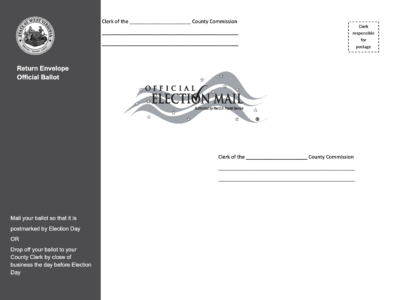
The proposed rules were to include envelope standards across all 50 states with logos denoting the envelopes were "Official Election Mail" and unique bar codes for tracking. States using mail-in ballots would have to notify the Postal Service 90 days prior to an election. States would also be required to turn over their lists of voters approved to receive a mail-in and/or absentee ballot as well as unique ballot identifiers.
A group of states filed a lawsuit to block the executive order in the U.S. District Court for the District of Massachusetts. Judge Indira Talwani issued a ruling in June blocking key provisions of the order, finding them unconstitutional. A second ruling on Aug. 11 by Talwani expanded the ban on implementing the executive order to all 50 states. The 1st U.S. Circuit Court of Appeals upheld Talwani's initial order in July.
In its ruling Monday, the Supreme Court did not address the constitutionality of Trump's executive order. Instead, the majority opinion stated the challenging states lack Article III standing and that their claims are not ripe because the order is an internal directive that has not yet resulted in a final, binding rule. According to the ruling, the states’ fears of future prosecution or administrative burdens are speculative and do not constitute concrete legal injuries.
"The Court's disposition of this application does not mean that any measure taken by the Government to implement the Order will necessarily be lawful. On that score, time will tell," according to the unsigned majority opinion. "But the Order itself does not harm the States, so the District Court lacked jurisdiction to bar the Government from trying to implement it. And for the reasons discussed, that injunction is likely to irreparably harm the Government if it remains in place while the appellate process runs its course."
The Postal Service mail-in ballot rules were not finalized until Friday, but according to this rule, the Postal Service "will not take actions to implement the rule specifically for the 2026 election unless and until the government obtains relief from those injunctions.
"If the government obtains timely relief from the injunctions, implementation immediately thereafter will provide election officials as much time as possible before the next election to comply with the rule's preparation standards for Federal Ballot Mail envelopes, and to prepare to submit data to the Federal Ballot Mail Portal ... before the mail-in and absentee ballots subject to this rule are mailed (which generally occurs in September or thereafter, as determined by state law)," the rule continued.
David Cook, West Virginia deputy secretary of state and general counsel, said Tuesday that because the mail-in ballot rules were not in place at the time of the March lawsuit, the majority of the Supreme Court had cause to issue the stay.
"The reason that the stay order was issued (was) because of a standing issue," Cook said. "Standing is relevant when the lawsuit is filed. So, in other words, because the rule had been implemented while the lawsuit was in effect, it doesn’t affect the standing argument when the lawsuit was filed. So, the Supreme Court said it was too speculative at the time it was filed."
Supreme Court justices Sonia Sotomayor and Elena Kagan dissented from the majority ruling, arguing that the states face imminent harm from resource diversion, costs associated with overhauling election systems and "credible threats" of federal prosecution.
"Today's decision does not address whether the President's attempts to interfere with States' administration of the November 2026 elections are lawful," the justices wrote. "Nor does it suggest that the Executive Branch has any constitutional or statutory authority to implement the President's directives. Instead, today's decision merely postpones adjudication of those challenges."
In a separate dissent, Justice Ketanji Brown Jackson warned that the ruling creates "pre-election chaos" and an "inequitable result" by preventing timely judicial review of a potentially unconstitutional federal intrusion into state-run elections.
"States administering elections and the voting public that relies on them to do so deserve clarity, not caginess or confusion," Brown wrote. "The Court does a disservice to all concerned by distorting Article III standing and ripeness principles to issue a ruling that contributes to pre-election chaos instead of quashing it, and by using its equitable authority to facilitate a patently inequitable result."
Cook said there are other lawsuits, including the by NAACP and the Campaign Legal Center, challenging Trump's election integrity executive order, which also orders the Department of Homeland Security and Social Security Administration to provide states with lists of verified citizens eligible to vote and orders the Department of Justice to prioritize criminal investigations against officials or entities that distribute ballots to ineligible individuals.
"(Monday's ruling) didn’t affect the substantive arguments that are going to be raised regarding whether or not the states have to follow the rule," Cook said.
The Supreme Court stay only deals with the limited case affecting 24 states and not with the Aug. 11 injunction affecting all 50 states and Washington, D.C., meaning that the Postal Service mail-in voting rules remain blocked for now. Cook said there are also several steps that would need to be followed before the mail-in ballot rule could be implemented.
"As it relates to West Virginia, there’s steps," Cook said. "The executive branch has to implement certain parts of the rule. Once that happens, you’re going to see another flurry of lawsuits come out and we’ll go from there. But at this point, the final rule doesn’t affect West Virginia in any way. Obviously, we’re going to monitor it because that’s what we do."
There are multiple permitted reasons or excuses for obtaining an absentee ballot in West Virginia, including for illness or medical reasons, physical disabilities, those who work long distances, those in the military or overseas, college students and those with temporary residences outside their home county.
According to the Ballot Specifications Guide published by the Secretary of State's Office, absentee ballots are required to have unique numbers and have "Official Ballot" printed on them. Voter who receive absentee ballots can track their ballot through their local county clerk or GoVoteWV.com. County clerks will begin mailing out absentee ballots between Sept. 18 and Oct. 29 for applications received by Oct. 28.
During the May primaries, 5,098 absentee ballots were requested, with 3,941 absentee ballots returned. The majority of absentee ballots (1,931) were cast by registered Democrats, followed by 1,586 by registered Republicans, and 298 ballots cast by those with no party registration.
(Adams can be contacted at sadams@newsandsentinel.com)