
Farmers market grows into a Wintersville tradition
Locally grown food makes a difference
Trending
WINTERSVILLE -- The end of the growing season is likely closer than many area residents want to believe, but that doesn’t mean there aren’t opportunities to find locally grown fresh produce.
Those include the Main Street Farmers Market, which is open from 4:30 to 6:30 p.m. each Wednesday in the parking lot of Blessed Sacrament Catholic Church.
It’s different from some of the other farmers markets in the area, organizers and vendors said, because it is held in the evening and features locally produced products.
“We started it because we had a lot of farmers who worked during the day, and they couldn’t make it to the farmers markets that were held during the daytime unless they were held on a Saturday,” explained Wendee Dodds, administrator of the Jefferson Soil and Water Conservation District, which sponsors the weekly gathering.
“We have anywhere from eight to 15 vendors in a season, and we have a mixture of everything,” she continued. “We have a wide variety of locally grown produce. We do have a vendor from Weirton, but last year, all of our vendors were from Jefferson County. They are all within a very close local area.”
Like all markets, it features produce, baked goods, fresh-cut flowers, artisan breads, honey, pumpkins and gourds, goat’s milk soaps, salves and lip balms and jams and jellies.
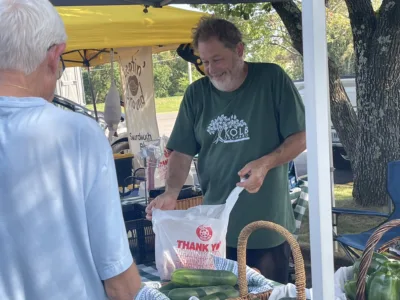
“This particular market is one that you have to grow things yourself,” Wally Sadowski of Kolb Orchard said between customers during the Sept. 2 market. “There are a lot of markets out that that allow re-sellers.”
The market has been open since 2010, Dodds explained, though its location has changed. It began in the parking lot of the former Eastern Gateway Community College along Sunset Boulevard in Steubenville. When that school expanded its training program for the trucking industry, the market moved to its present location along Main Street in the village.
Selling items at the farmers market is important to vendors like Shannon Hull.
“We try to reconnect people to their food sources,” she explained. “Food just doesn’t come from a grocery store. Unfortunately, that’s where most people think it originates from. I have honey from my own hives, a seasoning mix that I make and different jams and jellies from fruit I have raised myself.”
Dodds said the list of vendors varies each year, adding that some have been a part of the market since it opened.
“It’s almost like a business incubator,” she said. “A lot of the time we will have vendors who come and stay for a year or two or three and they will get their own customer base and start selling out of their homes. We do lose vendors that way, but we generally pick up new ones and the process starts over.”
Because the market is held on a Wednesday, it falls at the same time Wednesdays in Wintersville is presented during the summer months. According to Dodds and Joel John, the market actually helped to inspire the volunteer committee that organizes the monthly street fair.
“They knew the market was here, so they kind of wanted to build on that,” Dodds explained. “In the beginning they talked with us about having a joint event.”
“The farmers market being here actually inspired Wednesdays in Wintersville,” said John, who heads up the Wednesdays in Wintersville committee. “There was a woman named Linda Freed, and she was very involved with the farmers market. She is actually the one who reached out to myself and another business owner in the community and asked, ‘Why don’t you set something up here and add onto this? It’s a great asset to the community -- let’s make it better.’
“This grew from the farmers market,” he added. “We’re happy that the farmers market has always been a part of this -- and it really inspired Wednesdays in Wintersville.”
Wednesdays in Wintersville has concluded for the season, but the farmers market will go on for several weeks, Dodds said, with the last edition of the season tentatively set for Oct. 7, though it could be extended.
Overall, this year’s market has attracted more customers, Dodds said. A part of that likely can be traced to the cyclospora parasite outbreak that was linked to iceberg lettuce and led to a recall by Taylor Farms. The processed lettuce had been sourced from Mexico and led to 110,000 reported illnesses across 20 states -- including Ohio, Pennsylvania and West Virginia -- according to the Centers for Disease Control and Prevention.
“I don’t know if that’s because of nervousness about buying things in the grocery store, but these people who come to our market generally know our vendors. They know how the food’s grown and where it’s grown. I think they do trust it,” Dodds said.
Sadowski said that quality is important.
“We’re a no-spray farm,” he said. “Everybody knows our produce is picked that day. It costs a little bit more, but I think its worth it,” he said.
That means a lot to customers like Brenda and Jim Reed of Toronto.
Jim Reed said that the produce is what brings them to the market and that he and his wife appreciate that it is locally grown.
“I personally buy all of my produce here throughout the summer,” Dodds said. “And, knowing what I know about some of the issues that we have been experiencing with food safety, I’ve noticed other people coming here primarily for their produce, too.”