
Local historian chronicles memories of Beatty Park
Trending
STEUBENVILLE -- Flora L. VerStraten-Merrin is a local historian and was a driving force behind the formation of the Friends of Beatty Park.
In the final stages of writing a book about the park, she says it has brought her to the realization that park was and still is a connective historic site for the community of Steubenville. She adds that anyone who is interested in the history of the park, the adjoining historic Union Cemetery or the people “out the run,” (South Enders) also has to be interested in the history of the community of Steubenville.
VerStraten-Merrin has put together an extensive history while compiling research for her book, which is being edited by Sandy and Greg Day. She expects to have the book finished and available locally and through Amazon before the end of the year.
She said that she first spotted the park lands on a map dating to 1797 and what is now the entrance of the park was identified as “nature lands.” The term nature park or nature preserve did not exist at that time.
While little is known about the park lands what is known is that the unsettled lands of the park area were filled with ancient tree canopy and were a plentiful source for various berries and nut-producing trees, VerStraten-Merrin said, adding the stream attracted wildlife and nourished the lowlands throughout the entire area.
“The ancient hemlock grew in the heavier wooded areas including the adjacent Union Cemetery. From the hemlock a large demand and business was created -- the tanbark industry was extensive. The hemlock created an important source for tannins (the process of extracting the tannin from the tree bark) to tan leather and it had many other important pioneer uses,” she explained.
There was a copperas business on the parklands, which was created from crystallized iron salt found in the area, and this was used for making black ink and dyeing wool, cotton and hats black. The iron pyrites (often referred to as fool’s gold) were exposed to the air and water to oxidize them, and the resulting acidic runoff was boiled and crystallized to make the chemical, she added.
“A busy stone quarry neighbored what is now the Lincoln Avenue entrance to the park. The quarry employed strong men and those working there were referred to as stonebreakers. A road was built from the stone quarry and went up through the parklands (now the Purple-Old Stone Lodge trail) directly to the cemetery. The beautiful stone was used for the 1880 bridge in the cemetery and many of the walls, stone fencing (much of it gone now) and the mausoleums, sidewalks and ornate displays in the oldest sections of the cemetery,” VerStraten-Merrin said.
In 1853, the Rev. Charles C. Beatty, a Presbyterian minister, and the newly formed Union Cemetery Board were searching for land to form a new cemetery -- away from the downtown. At this time, the area where the cemetery and park is located (several hundred acres of land) was being used for farming and much of it was untouched, she explained, adding that ancient tree canopy, animals and plants were plentiful.
“Beatty had a love of nature, and the lands of the Huscroft farm and south of it were very appealing to him. While members of the board considered several pieces of land, Beatty had a vision of nature and all of its components when it came to developing a new cemetery. He sought advice from large cities that he had visited, and for horticulturists and well-known landscapers (think Oglebay, Columbus, Pittsburgh and Cincinnati) to give him advice. He loved the rolling hills, the stream running through the land and all the types of native wildflowers that could be found,” VerStraten-Merrin said.
After a lengthy search, the board decided on the Huscroft farm. At that time, purchasing the cemetery lands did not include much of the parklands below the cemetery that is now known as Beatty Park. It didn’t take long until Beatty started purchasing the land, in parcels, and donating the land and its deeds to the cemetery.
“He began developing the park area to attract the community to enter from the south end to avoid the horrible conditions of the old plank road and the fees associated with paying the toll. By 1874 he had obtained the 99 acres below the original cemetery parcels and began plans to tie the property together and promote the cemetery (and parklands) as an area to idle the hours away, to picnic, linger, read and to take leisurely walks. The stone arched sister bridges were added in 1874 and 1875 to add to the experience and convenience of active funeral processions that took the 1-mile trek from the ornate park entrance to the oldest sections of the Union Cemetery,” VerStraten-Merrin said.
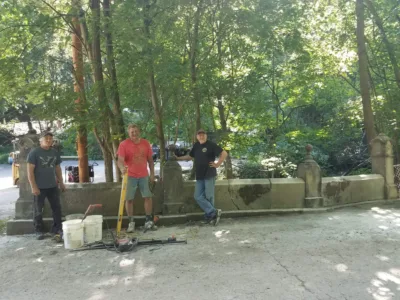
All of the bridges were built with nature in mind. They were intended to blend perfectly with the backdrop of the stone hillsides and the hues of greenish-blue vegetation which included a wide variety of wildflowers and plants and towering native trees. The South End entrance, also known as the spring entrance, was built during this time and included an elaborate entrance she said her research has shown
“The sandstone was carved by the Flotos, who also built the bridges, and was very large and ornate,” VerStraten-Merrin said. “It included wrought iron fencing and a sandstone-trimmed wall to protect the entrance from the road. There was a little store, called the Bray Store, that provided fresh spring water for humans and beasts, before taking the 1-mile ride or walk to the cemetery.”
Beatty encouraged biking and horse carriage rides and developed a road that circled the parklands. He developed and built rock ditches to carry water away from the dirt road (now the hiking trails) and by 1888 had a 220-step staircase with 17 stone landings built up the side of the park hillside, connecting the park to the newly developing hilltop residents on Pleasant Heights.
“He wanted the cemetery and parklands to be accessible to all communities in Steubenville and beyond. The entrance from the toll road, the entrance from what is now Lincoln Avenue and the entrance from the stone staircase on Pleasant Heights all denote his desire to invite all to this lovely park. He knew that the Beatty Park lands would encourage use of the park lands and would bring more visitors to the cemetery,” VerStraten-Merrin said.
“Back then, the parks were the cemeteries. They were visited at least weekly by loved ones, who brought picnic meals and spent time talking to the living and the dead,” she added.
Another thing that was instrumental in the park’s growth from 1888 and to about 1937 was the installation of the streetcar and trolley system in Steubenville.
“It just so happens that one of the first routes included a drop-off and pick-up point at the top of the stone staircase, at the top of the Beatty Park lands. Now, people could take a streetcar from all points of its route and come to the park. To me, that was really smart thinking and Beatty must have been very pleased,” VerStraten-Merrin explained.
“In 1929, there was some talk about the city purchasing land for a park and swimming pools. This was the beginning of parks being developed in the city, she explained. However, the city finally paid for 99 acres and at a city meeting, many officials wanted to name the park, Union Park, but some officials and citizens (most likely South Enders) spoke up loud and clear and the park was named after Charles C. Beatty, as it should have been,” she added.
Not long after the city purchased the land, a plan was made to build a 150-foot long swimming pool, an area that would become the concrete bleachers, and the decision to tear down parts of the front cemetery entrance, leaving what is there today -- a more “park-like entrance appearance.”
Some, but not all of the work, was done in the 1930s by the Works Progress Administration -- part of the New Deal), and the workers were gone by the early 1940s. The pool was not built by the WPA -- the new entrance was, the new caretaker’s house was and some shelter houses were -- but much of the historic portions of the park were constructed well before the city owned the property, VerStraten-Merrin said.
“The original pool closed in 1974, and a new pool was built the following year in another area, and it later closed as well. Many features over the years have been torn down, due to neglect or age with little to no maintenance during the late 1990s through the fall of 2019, when the Friends of Beatty Park decided to organize and begin to revitalize the park,” she said.
The group is active in the park, and goals continue to upkeep the park, save historic features and work with the city and parks to locate funding for ongoing projects.