
Rotary Club donates funds toward JeffCo community playground
Trending
STEUBENVILLE -- Members of the Steubenville Rotary Club made a donation toward a local project, learned details about another donation and heard from the district governor during Wednesday’s meeting.
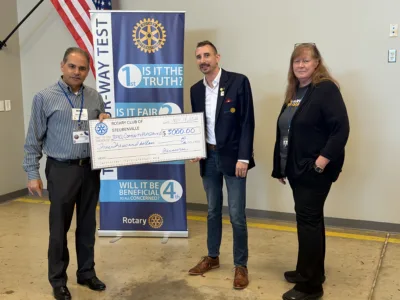
The club donated $5,000 toward the funding of the JeffCo Community Playground during the meeting. Planned for Jim Wood Park in the city’s West End, the accessible playground will provide an inclusive space where people of all abilities can play, connect and thrive.
“When it’s done, it’s going to be a beautiful park for kids of all abilities,” said Mike Zinno, superintendent of the Jefferson County Board of Developmental Disabilities and a member of the Rotary Club.
Fundraising is underway for the $1.8 million project, which is a collaboration among JEFFCO Services Inc., the city of Steubenville and its Department of Parks and Recreation and Unlimited Play, a 501(c)(3) nonprofit based in St. Peters, Mo., that partners with Little Tikes Commercial to help plan, design and build fully accessible playgrounds.
Local donations and grant money will fund the project. When it is completed, the facility will serve residents from across the Tri-State Area, officials have explained.
Joining Zinno for the check presentation were Lorrie Raymond, president of the Rotary Club, and District 6650 Gov. Ryan Boyce.
Jim Baber told members 80 coats the club had purchased through Operation Warmth had been delivered to Urban Mission Ministries for distribution to area children.
Boyce, a member of the Salem Rotary Club and manager of Adamson Veterinary Services, told club members the donation to the playground project was an example of putting into action the theme for the 2026-27 year shared by International President Olayonka Babalola.
“When I got the opportunity to join Rotary, what was so cool is that it’s like one droplet within a lake, and the ripples just carry out,” Boyce said. “The scalability of that one person within that community who can create an act, that is phenomenal, because it’s a tool, and it’s a phenomenal tool. And, each and every one of us wearing the logo is part of that tool, and each and every one of us has an opportunity to utilize it to create impact, and you are, as you did with the $5,000 check for the park.”
Rotary, like many service organizations, has expanded its reach across the world since it was founded in 1905 in Chicago. Of its more than 45,000 clubs, about 45 are located in District 6650, which covers Eastern and Northeastern Ohio. And, every June, the leadership of the group changes, from the club level through the international president.
Its action plan, Boyce explained, includes four priorities -- adapt, engage, reach and impact -- members and clubs should think about anytime they are changing anything and moving forward.
These priorities interested him, Boyce said, adding when he became the district governor and thought about those four terms, they made him think about one group in particular -- young people.
“The youth are our future. They are our future leaders. Youth are our future Rotarians. Youth are the ones who are most likely to adapt, and the youth are the most likely to get engaged,” he added.
While the avenues to get young people engaged do exist, they are not necessarily being used to their greatest effect.
The Rotary youth exchange program, he said, not too long ago had 68 inbound and outbound students from the district involved. This year’s total is eight. Why this is can be traced to several reasons, including cost -- it’s about $12,000 (which is a lot less than the $30,000 other exchange programs can run) -- anxiety felt by family members after reading about and seeing reports concerning situations around the globe and the length of the program, which covers one year.
Rotary now offers a short-term program, which doesn’t involve as much money or as much time -- only four months.
He added clubs in the district sponsor with Interact Clubs -- which are geared toward middle and high schools -- but there is not a Rotoract Club in the district to serve college students and young professionals 18 and older. With the number of colleges, universities and trade schools located in the district, the opportunity to start those clubs is there, Boyce said.
Attracting younger members is an issue with most service organizations, including Rotary, he added. Using 40 as the cut-off age for a young professional, only 8.2 percent of the 1.2 million Rotarians around the world fall into that group.
“With young professionals, we think about ourselves and we think of what we do and how do we adapt it so that we get others involved with us,” Boyce said.
“A lot of times, we think change is hindered by rules and regulations -- we can’t do it because of those rules and regulations, this is what they say -- and those tricky bylaws. But the rules and regulations can be changed, bylaws can be switched or tweaked with the stroke of a pen and a few votes. It’s not always the rules and regulations that hinder us and our abilities to change and adapt. It’s actually, sometimes, tradition -- this is the way it is, this is how it’s been, this is what I always do, this is where we are going. Sometimes, this mindset is what hinders our ability to change and adapt,” he added.
It’s something Paul Harris, the founder of Rotary, recognized when he said that for Rotary to exist and co-exist and move forward, we must be willing to adapt, Boyce added.
By working together, Boyce said, Rotarians can make a big impact on the world.