
Simplifying support for our education
When politicians talk about the amount of taxpayer money available to help with everything from education to infrastructure improvements, they get a little quieter when it’s time to look at how hard the federal government makes it to jump through all the hoops to actually get that money.
It makes some sense, when dealing with state and municipal governments or large corporations. It makes much less sense to crow about how much money is available to help individuals for whom the red tape might be overwhelming.
U.S. Sen. Shelley Moore Capito, R-W.Va., has joined forces with Sens. Susan Collins, R-Maine, Jon Tester, D-Mont., and Tammy Baldwin, D-Wisc., to introduce the Educational Opportunity and Success Act, which would reauthorize and strengthen federal programs meant to help underserved students get access to college education support.
“TRIO Programs help provide students in West Virginia, and across the country, with the resources and knowledge they need to pursue higher education opportunities. I’m proud to reintroduce this bill, which will enable future students to take advantage of opportunities provided by TRIO. Helping our young men and women receive a high-quality education and build a lifetime of success is vital to the future of our state, and TRIO programs are so helpful in that mission,” Capito said.
Among the aims of the bill are to establish reasonable guidelines for notice of pending grant competitions, remove administrative burdens, update the application process and update eligibility criteria.
“Recognizing that some students may not go on to higher education immediately after high school or earn a degree within 2 or 4 years, this bill would update criteria for several TRIO programs to provide greater flexibility to non-traditional students, including veterans,” Capito’s office said.
Some of the changes sought are to bureaucratic standards that have been in place since 1980.
If simplicity, accessibility and common sense can help more students receive an education that brightens not only their future, but our country’s, lawmakers should not hesitate to make it happen.
Editorials
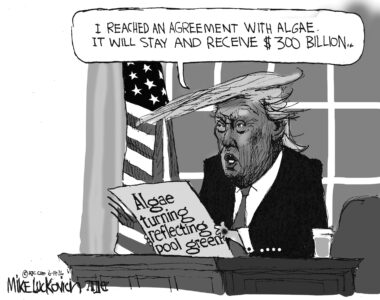
Editorial cartoon
Remembering our history, strength, and people
The country roads are taking us all home this weekend as we take time to recognize the anniversary of our state's ...
For Americans and Our Guests, the World Cup Runneth Over
Psalm 23:5, one of the best-known biblical passages, says, "Thou preparest a table before me in the presence of ...
Elon Musk’s new ‘trillionaire’ status is a good thing, actually
I am not a huge fan of Elon Musk as a political activist or commentator. I think he's made Twitter — sorry, X — ...
A Republic or an Empire?
The Declaration of Independence of July 4, 1776, embraces two value sets. The first is natural rights, and the ...
NBA champs? It’s the New York Knicks… finally!
It has been 53 "short years" or "just" 19,698 days (May 10, 1973) since the New York Knicks were NBA ...