Time waits for no man, but Tom Borkowski can fix it
Smithfield-Dillonvale native known for ability to understand, restore mechanical clockworks
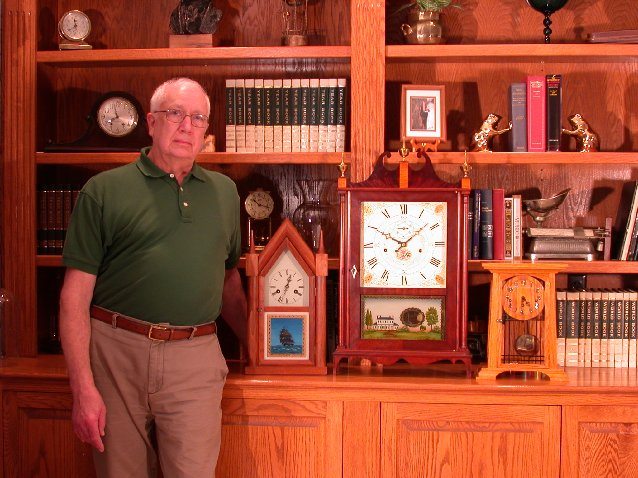
Tom Borkowski made the three clocks at right. The largest of the three is a copy of wood works clocks made from 1815-1838. The clock on the right is a prototype he made for a Cleveland clock dealer. It is an original design. The steeple clock was made in the late 1800s. He co-authored a book “Clocks of the Art Nouveau and Art Deco Style 1890-1940. — Esther McCoy
Daylight savings time starts Nov. 6, a time when everyone with a time piece that needs adjusted will be turning back the hands. In the Tom and Linda Borkowski household, it would be a daunting task if all of their clocks had to have time moved backward. The couple is from the Smithfield-Dillonvale area but reside near Cleveland now.
It is in this Cleveland area that he encountered old clocks in need of a complete overhaul and/or refurbishing. And he has done both to clocks for himself, friends and those who need someone to look at and understand the workings of a clock and what to do to restore them.
Tom is a horologist, one who practices the making of clocks or watches, an expert maker of time pieces. There are numerous clocks in their home but some, although in working condition, are not doing so. They have a historical display of his work, from Germany, Norway, France and the United States, and a collection of old and repaired time pieces that some thought were too far gone to matter.
He became interested in old clocks after purchasing a grandfather clock in 1983 and becoming a member of the National Association of Watch and Clock Collectors, taking classes on restoration and repairs.
“I have restored many clocks and made one with its working movements made of wood. This kind of clock was made from 1815 through 1838 rather than brass movement,” he said.
He turned a mantle clock — made between 1865 and 1913 — a Seth Thomas 30-hour, brass movement, weight-driven clock, into a work of art that performs perfectly as long as it is wound each day. The clock belongs to Evelyn Clouston who wanted it refurnished and put back in working condition for her son, John.
“It took about 12 hours of total work. I tore the movement completely apart and put it back together, cleaned the case and gave it a new look with Kolton Kleanser and Kiwi shoe polish to wax the wood. The case is referred to as an “OG” clock, a common style made by many clock companies of the 1865-1913 era. The term OG was used because the front molding is similar to OG molding used in house and furniture trim,” he explained.
“Such brass movement clocks were mass produced and sold for about $4.70. I think Evelyn’s clock was once worked on by Carl Penn, a well known Smithfield clock repair man in the early years,” Borkowski pointed out.
The Borkowski home has anything from miniature clocks, miniature cuckoo clocks and three grandfather clocks. One of the 5-foot clocks with a 14-inch dial (face) is by E. Howard Co. of Boston.
There are only two clocks running at a time in the home. It would be too much confusion if they were all in operation at once.
“You will find that many of the old clocks are stored in attics or basements, and heat and humidity are the worst things on a wooden clock,” he acknowledged.
He told of hearing about the Paxton and Hill clock that was attributed to Steubenville. The clocks were made in the Pennsylvania design and were tall-cased with brass movements. It is told that to date, the results of their work were of insufficient quantity to have warranted a great deal of research. As a result, it is not certain who either one were but there were two clockmakers by the name of Hill that were noted as working in Steubenville. One was A. Hill and the other Charles Hill. Only Charles has working dates associated with the clockmaker, 1823-25. It is not known which Hill, if either, was the partner of Paxton.
Borkowski served as president of the Cleveland Chapter of the clock organization for four years and was chairman of two national conventions held at the Cleveland Convention Center, with 3,300 attending in 1996.
It is held in different locations every 10 years, he noted.
He co-authored a book “Clocks of the Art Nouveau and Art Deco Style 1890-1940,” as well.
“I can make all working parts of a clock, as I was a machinist in my younger days. I have a workshop in my basement and do woodworking in our garage,” he said.
(McCoy can be contacted at emccoy@heraldstaronline.com.)
Local News
Hancock County’s America250 mural moving forward
Jefferson County grand jury indicts four
STEUBENVILLE — A Sherman Avenue resident who allegedly threatened an individual who had provided information to ...

Kiwanians honor Steubenville High boys basketball team
Community Briefs
Arrests made in copper theft CHESTER – Two area residents have been arrested in connection with the alleged ...
Grand jury returns indictments in drug, intimidation cases
STEUBENVILLE — A Sherman Avenue resident who allegedly threatened an individual who had provided information to ...