
A look back at 2020 session
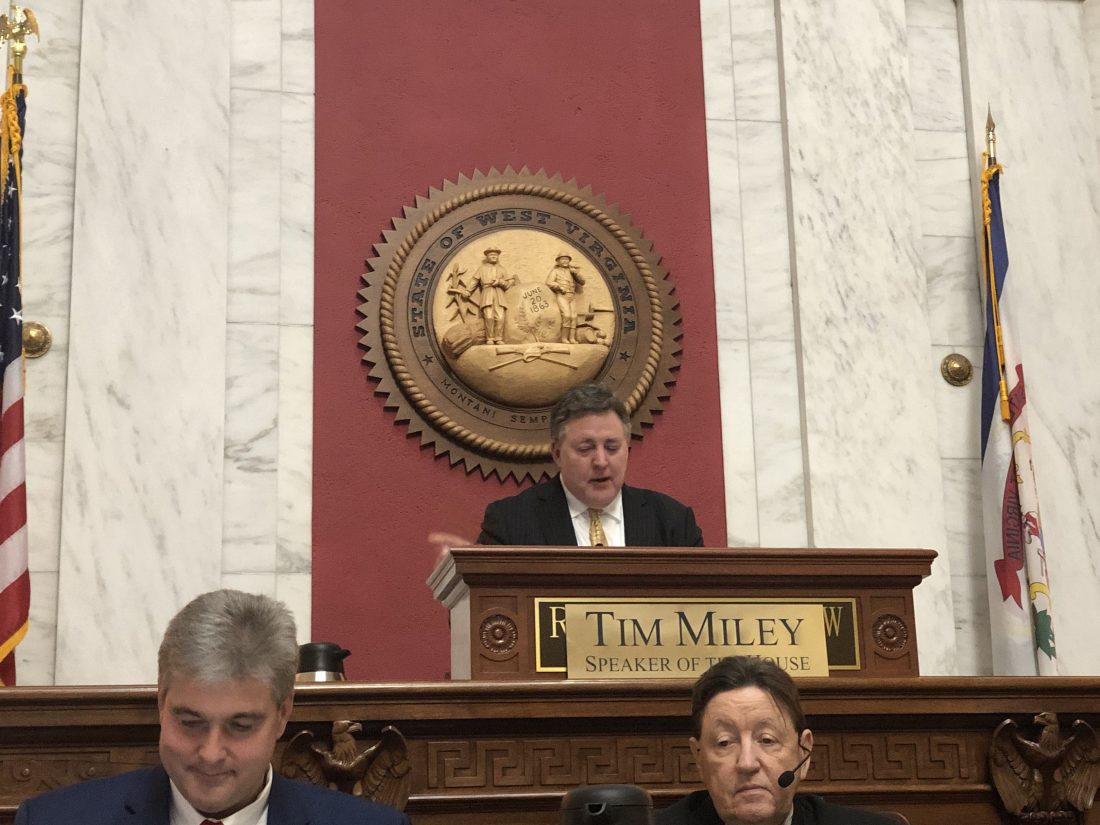
REMARKS — House Minority Leader Tim Miley, a former House Speaker, takes the dais one last time to give goodbye remarks. -- Steven Allen Adams
CHARLESTON — The 60-day legislative session for 2020 wrapped up at midnight Saturday night, with leaders in the state Senate and House of Delegates taking stock of the bills that made it, while Gov. Jim Justice was pleased that most of his proposed budget remained intact.
When the Legislature gaveled out at midnight Saturday, lawmakers passed 354 bills, with 186 House bills passing and 168 Senate bills passing. According to the Legislature’s website, this was the first time since 2002 that the Legislature topped more than 300 bills passed.
Bills making it over the finish line Saturday included major reform and funding for the state’s exploding foster care system, a sovereign wealth fund to spur major economic development projects, a $100 cap for insulin co-pays, criminal justice reform measures to help decrease jail populations and put people back to work, and bills to encourage broadband expansion.
“We think it went fine,” said House Speaker Roger Hanshaw, R-Clay. “We’ve done some good things.”
“We moved the state substantially forward in terms of foster care reform, in terms of managing a state budget in a responsible manner,” said Senate President Mitch Carmichael, R-Jackson. “We’ve addressed the substantive issues that confront the state in terms of opioid addiction, jobs, growth, and our foster care crisis.”
The Legislature adopted a compromise general revenue budget for fiscal year 2021 starting July 1, totaling $4.574 billion. The budget included $16.9 million for the new tiered foster care system in House Bill 4092 to increase reimbursement rates for foster and kinship families, $19 million to end the intellectual and developmentally disabled (I/DD) waiver waitlist, and also included funding for Justice’s Jobs and Hope program, the Communities in Schools program, and a second West Virginia National Guard Mountaineer ChalleNGe Academy in Montgomery.
“I really think if you go back and look at the State of the State, we got it all done,” Justice said. “We have done a historic budget in placing our families really first, whether it be I/DD, the Mountaineer ChalleNGe Academy, foster care, Communities in Schools, on and on and on. We’ve done it in an economically prudent and responsible way. We’ve reduced the budget. It’s unbelievable what we’ve accomplished, and I could not be happier.”
Hanshaw pointed to several bills which will help make reforms to criminal justice with the aim of giving people a second chance and getting back into the work force. These include expanding what crimes can be expunged from a person’s record, an alternative sentencing program for work release, waiving certain fines and fees for completing substance abuse programs, and creating a sentencing commission.
“We’ve done some things to do economic development to put people back to work.” Hanshaw said. “We lowered some barriers to getting people back on the payroll. We’ve made it easier for people to get back drivers’ licenses. We’ve created the Mountaineer Impact Fund in House Bill 4001. All those things taken together make it easy to see we’re trying to get people back on a payroll here.”
HB 4001 creates the West Virginia Impact Fund and the Mountaineer Impact Office. The sovereign wealth fund will allow foreign investment into the state for major economic projects that need funding, such as the Appalachian Storage Hub or natural gas cracker projects. Hanshaw said the board of directors should be announced shortly, with projects lining up to participate in the fund.
“Now that the bill has passed the Legislature, we expect the governor to sign it next week,” Hanshaw said. “It’s about creating employment opportunities for the average West Virginian. It’s about putting the kinds of facilities we talk about here on the ground and actually employ construction workers, the clerical employees who will staff them, and the tradesmen and women who will keep them in operation. It’s about building big things.”
“It’s a great tool in the toolbox. It could even be the hammer,” Justice said. “What that is going to do is it’s going to bring dollars into the state to develop a fund to be able then to give us the opportunity to marry up investors and/or people who are wanting to put a business in. Maybe they don’t have all the money, but they have the greatest idea in the world. It’s a great idea and I’m very happy we’ve got it now.”
For the two leaders of the Democratic minorities in the Legislature, Saturday night was bittersweet. This was the last session for Senate Minority Leader Roman Prezioso, D-Marion, and House Minority Leader Tim Miley, D-Harrison, who are both retiring from legislative service. Miley, who was invited by Hanshaw to give his goodbye remarks from the dais where he once presided over the body as a former House Speaker, said afterward there were many good things done this session.
“I thought it was a pretty productive session,” Miley said. “We passed some good bills and funded some good programs. We worked in a pretty bipartisan manner to do so. It wasn’t a contentious session I don’t think. Sure, there were some bills and issues we didn’t agree on and differed as parties, but by and large I thought it was a productive bipartisan session.”
Still, there were some bills that died early on in session. Hanshaw said he was disappointed that some of the House’s occupational licensing reforms didn’t make it. Miley said he regretted lawmakers couldn’t agree on changes to the Medical Cannabis program. Carmichael noted the demise of legislation ending the Greyhound Breeding Development Fund and the phase out of various tangible personal property taxes. Carmichael said lawmakers will return next year and try again.
“Obviously we always learn things, but if I had it to do over again, I’d do it exactly the same way again. You always stand for the principles you believe are right whether or not you’ve convinced the majority to follow along or not. It’s very important that people see the process and know how their representatives are voting on particular issues.”
(Adams can be contacted at sadams@newsandsentinel.com)
Local News
Boil order issued for McKinley Road area of Weirton
WEIRTON – The Weirton Area Water Board has issued a boil order for the area of McKinley Road following work on a ...
Ohio finds $1M in taxpayer funded childcare overpayments
After a what officials called a random sample review of taxpayer-funded licensed childcare centers in Ohio, a state ...
Special Olympians heading to national competition
June First Friday will be a day at the beach
STEUBENVILLE — The June edition of First Fridays on Fourth Street might be the most impressive in the event's ...

Shiloh Shepherds show off in Weirton
Wednesdays are for superheroes in Wintersville
WINTERSVILLE — Superheroes will be taking to the streets of the village for the June installment of Wednesdays in ...