
State Board of Education receives updated student discipline numbers
Graphic Courtesy/WV Department of Education

Graphic Courtesy/WV Department of Education
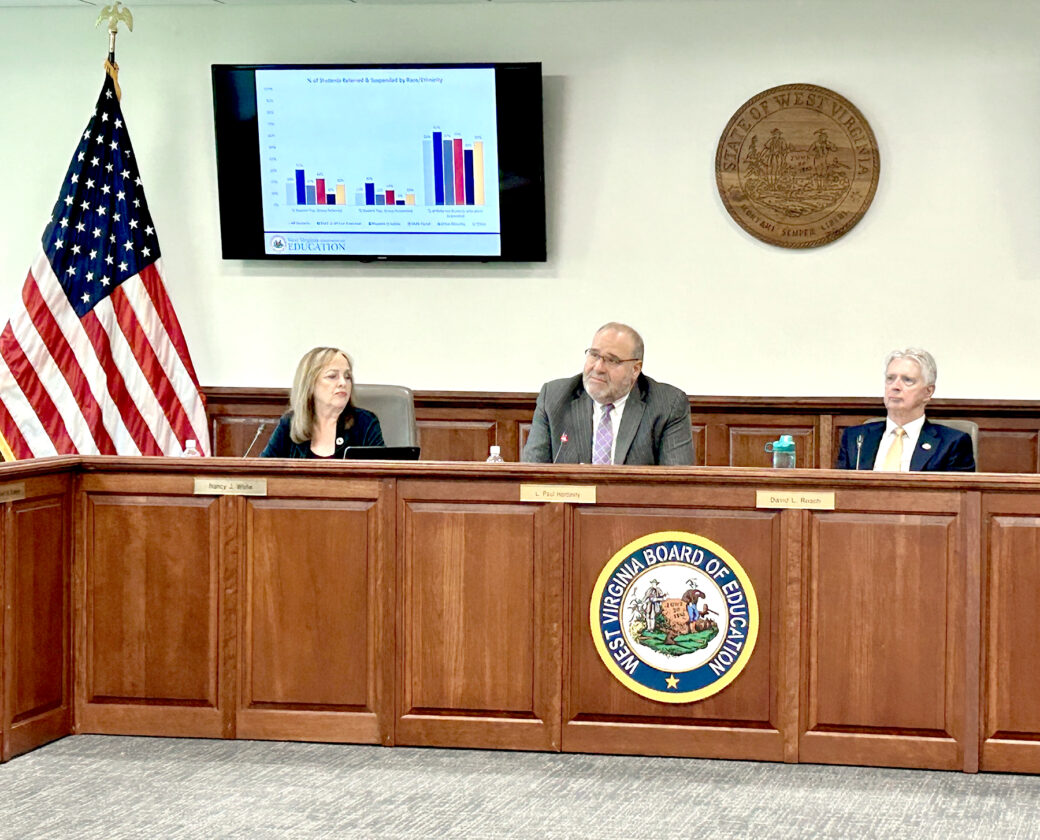
MEETING — West Virginia Board of Education President Paul Hardesty, center, tells fellow board members Wednesday that student discipline disparities were unacceptable. -- Steven Allen Adams
Graphic Courtesy/WV Department of Education
Graphic Courtesy/WV Department of Education
MEETING — West Virginia Board of Education President Paul Hardesty, center, tells fellow board members Wednesday that student discipline disparities were unacceptable. -- Steven Allen Adams
Trending
CHARLESTON -- The West Virginia Board of Education received a more detailed report on student discipline in public schools, with state education officials calling the numbers unacceptable.
The state board met Wednesday for its monthly meeting at the Department of Education offices on the grounds of the State Capitol Complex in Charleston.
Board members heard a report on West Virginia school discipline data presented by Drew McClanahan, director of Leadership Development and Support for the Department of Education, and Georgia Hughes-Webb, director of Data and Analysis at the department.
The updated report looks at school discipline data from the 2022 school year, including total discipline incidents, in-school and out-of-school suspensions, the numbers of students involved, and key demographic subgroups.
According to the report, there were 169,963 total discipline incidents during the 2022 school year, with 51,432 students referred for discipline. There were 66,904 suspensions, with 28,702 students suspended, many of whom were repeat offenders - one in every 10 students. The suspensions represent 177,777.75 of instructional days lost, with an average of 6.19 days lost per student suspended.
"That's pretty significant," Hughes-Webb said. "If you were referred for a disciplinary incident last year, chances are pretty good you were getting a suspension."
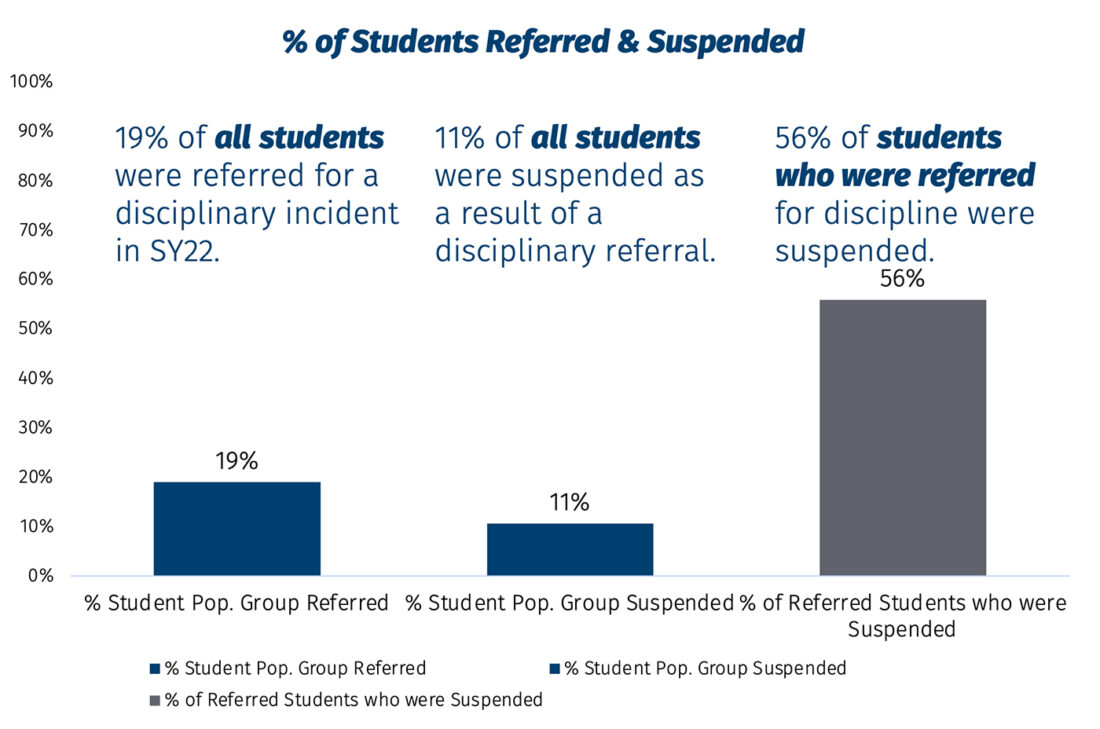
Looking at the data, 19 percent of all students during the 2022 school year were referred for a disciplinary incident, with 11 percent of all students suspended as a result. Of the number of students referred for discipline, 56 percent were suspended.
"We've got the punishment-side down pat, but that's the only thing we have down pat, and who has suffered because of that? Our children," said state Board of Education President Paul Hardesty.
Broken down by race, 31 percent of students referred for disciplinary incidents were Black despite Black students representing 4 percent of the student population in 2022. Multi-racial students represented 24 percent of referrals, 18 percent were white, 17 percent were Hispanic/Latino, and 10 percent were other racial minorities. Of those suspended, 20 percent were Black, and the percent of referred Black students were suspended were 64 percent.
Black students made up 8 percent of all students suspended, with 10 percent of Black students involved in incidents resulting in suspensions, and 11 percent of all instructional days lost due to suspensions was from Black students. Of those Black students suspended, 50 percent were in in-school suspension while 50 percent were in out-of-school suspension. Economically disadvantaged students and foster care students were also more likely to be placed in out-of-school suspension.
Students from economically disadvantaged families were also hit hardest by disciplinary referrals and suspensions, with 23 percent of economically disadvantaged students referred for disciplinary action and 14 percent suspended. Of the total number of students suspended, economically disadvantaged students made up 60 percent.
Foster students made up 34 percent of the total student population referred for discipline and made up 24 percent of students suspended. Of the number of students suspended, foster children made up 73 percent. Students with disabilities 23 percent of the total student population referred for discipline, 15 percent of student population suspended, and made up 65 percent of referred students who were suspended. Homeless students represented 29 percent of referrals and 17 percent of suspensions, making up 60 percent of referred students who were suspended.
Hardesty called for all branches of the government to come together - including the Legislature, Gov. Jim Justice, the Department of Health and Human Resources - as well as educators, community leaders, and the faith community to help fix the state's discipline disparity problem.
"Ladies and gentlemen, this board cannot fix this alone," Hardesty said. "We have laid our cards on the table here today. We have a problem of epic proportions. It's no wonder we're in the position we are on proficiency … We're failing our kids. This has to be a complete overhaul. We've got to do something different."
The Board of Education directed the department last December to expand the scope and depth of a report released in July on statewide data on school disciplinary actions required by the passage of Senate Bill 723 in 2020 after some board members and community advocates complained that the report didn't drill down into the data.
SB 723 required the Department of Education to look at statewide data on school disciplinary actions and develop a plan to reduce the number of disciplinary actions. The department is required to submit a report to the Legislative Oversight Commission on Education Accountability every two years.
One of the board members who was unhappy with last summer's report, retired educator Debra Sullivan, had one word to describe the new in-depth report presented Wednesday.
"Wow."
Sullivan said the new report was far more detailed and would present state/local education officials and the public a roadmap for finding ways to reduce the number of discipline incidents, identifying schools that are disciplining based on race or socio-economic conditions, and helping ensure those students receive the help they need to succeed.
"It's in-depth, it's comprehensive … and what you've done is given us an accurate picture of the state of our schools in terms of discipline," Sullivan. "Before, we just had sort of a feeling. But because of the data, we can drive solutions … this is an opportunity for us to change the dynamic. Before, we had a state outline, but now we know the road."
McClanahan said the department would begin this summer implementing a plan to reverse disciplinary numbers. Focus will be on in-person and virtual trainings with teachers and administrators with an emphasis on being less heavy-handed, working with local communities, looking at social-emotional supports, classroom management, and changing school culture.
"Our schools must be safe and must be conducive to learning, but we also have to understand that we can have an impact on how students behave and the continued behaviors that maybe we see," McClanahan said.
To improve data, a school discipline dashboard will be crafted. The data will allow officials to set up discipline data flags to find schools having problems. The department will also recommend policy changes, including an end to zero tolerance discipline policies, strengthening due process implementation, revisiting the four levels of discipline, and encouraging alternatives to suspensions and exclusion.
Hardesty praised Rev. Matthew Watts, a pastor on Charleston's predominately Black West Side and leader of the Tuesday Morning Group, an organization focused on economic and social justice issues. Watts and the Tuesday Morning Group have raised the issue of school discipline disparities for years.
"The Tuesday Morning Group commends State Board President Paul Hardesty, state board members and Superintendent David Roach for compiling and releasing the detailed analysis of West Virginia state school discipline data," Watts said in a statement Wednesday afternoon. "After over eight years of advocacy, the TMG is encouraged to see that there is finally a state school board and State Superintendent that is willing to recognize and acknowledge the severity and complexity of excessive student school discipline and suspensions."
Watts praised the department and state Board of Education for presenting an in-depth report and recommendations. He further called for a statewide summit on school discipline and called for a special session of the Legislature to allocate funding for programs to address the disparities and proficiencies issues in low-income communities and minority communities across the state.
It is the hope of the TMG that the recently released West Virginia school discipline data will serve as a clarion call to capture the attention and engagement of all stakeholders," Watts said. "Addressing school discipline is a challenge that calls for an all hands on deck response."
(Adams can be contacted at sadams@newsandsentinel.com)