
BHJ transportation plan nearly complete
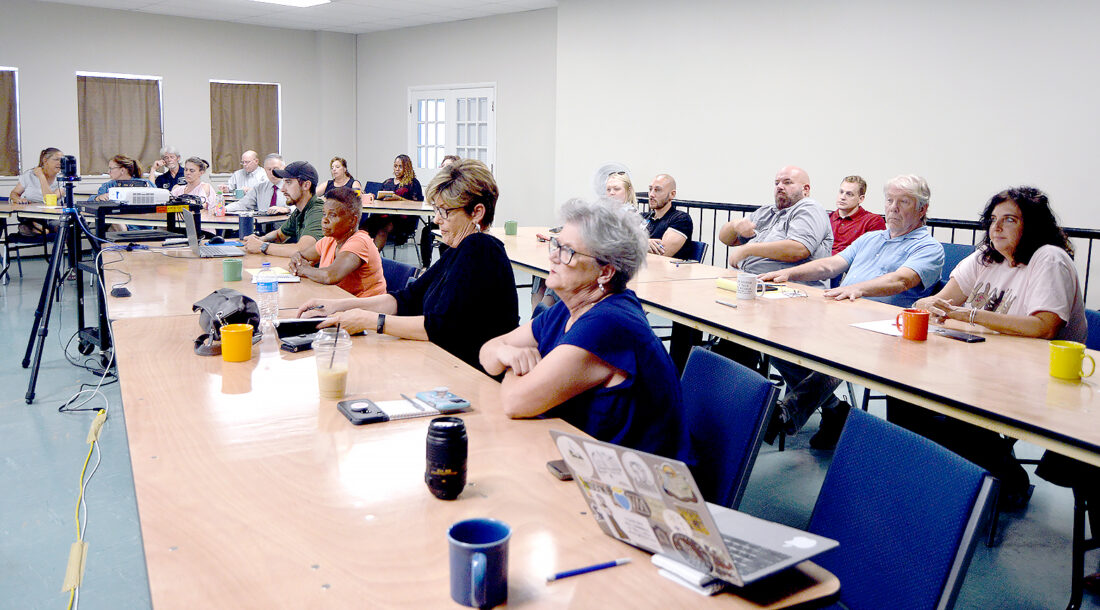
MOVING FORWARD — Transportation providers, human service agencies and citizens listen during the Brooke-Hancock-Jefferson Metropolitan Planning Commission’s second meeting to update its transportation plan on Wednesday. -- Christopher Dacanay
STEUBENVILLE — Jefferson County’s updated coordinated human services transportation plan is a month away from completion, a member of the Brooke-Hancock-Jefferson Metroplitan Planning Commission said Wednesday, following the organization’s second public meeting to address refinements for the plan.
Craig Brown, community planning director for BHJ, estimated the updated plan would be available in about a month, following a two-week public comment period on the draft. After that, the finished product will be posted on BHJ’s website and promoted on Facebook.
Brown said he was very excited with the second meeting’s “high level of public participation,” but added the updated plan’s implementation will be the ultimate responsibility of transportation providers and riders, as well as officials in charge of funding, like the county commissioners.
“As with any publicly created plan,” Brown said, “it’s up to the users of the services and the leadership involved to decide where it goes.”
BHJ’s Mobility Partnership for Human Services will continue to work on fulfillment of the plan’s goals, Brown said. However, stakeholders and riders will decide if the plan is acted on or not.
The transportation plan, as indicated by Brown, is focused on addressing transportation needs and gaps, particularly concerning the elderly, individuals with disabilities and low-income populations. The plan covers all of Jefferson County, but a separate plan for Brooke and Hancock counties will mirror what is done in Jefferson.
The plan will cover three to five years, said Matthew Townsend, transportation planner for BHJ. Michael Paprocki, executive director of BHJ, said the coverage is fluid, and the possibility exists of revisiting the plan every year.
Transportation providers, human service agencies and county citizens attended the meeting at the BHJ’s offices on the second floor of 124 N. Fourth St. to review the plan thus far and discuss strategies to address the needs and gaps identified during the last meeting.
Brown reviewed a list of transportation providers compiled during the last meeting. The list included Steel Valley Regional Transit Authority, Saline Township Transportation, Prime Time Senior Services, TranSmart USA LLC, PALS and other private companies and individual ride providers.
Specific needs identified at the last meeting and through a public survey were condensed into 11 bullet points and listed during the second meeting. The first of those needs was expanded transportation coverage in the county, specifically in locations like Amsterdam, Bergholz, Springfield, Richmond and, especially, Toronto.
Other needs included increased transportation for graduates to employment opportunities, medical trips outside of the county and state, commercial services and weekend services. Another need was consumer education on and marketing for available services, which Brown said included senior citizen outreach.
Also listed was the need for transportation for those who are being involuntarily committed for mental health reasons. Brown said this issue, which is new to him, comes about when someone needs to be committed but the facility is a long distance away.
“The issue is … how do you get these folks to these facilities when they don’t have family or the family’s not cooperative,” Brown said.
Townsend presented the results of a survey created by BHJ and distributed to individuals or places of interest, including libraries, public housing facilities and Toronto.
Townsend said there were 102 total respondents for the survey, which consisted of 14 transportation-related questions. Some questions regarded limitations respondents faced when trying to get to specific locations or activities.
Notable results included nearly 67 percent saying they drive themselves when asked how they manage their own transportation — 27.5 percent rely on carpooling and 20 percent walk or bike.
A question regarding the age of respondents “had a pretty good dispersion of ages,” Townsend said. Results reported that 36 percent of respondents were 65 years old or older, but only 7.8 percent were between the ages of 18 and 29.
The survey, Brown said, was conducted during eight weeks during the spring, and it was promulgated partly in person at certain places but mostly online and through various Facebook pages. The survey was met with critiques from the meeting’s attendees based on the reported age ranges of those surveyed.
Several attendees expressed that younger individuals were not represented as much as they should have been among the respondents. Brown acknowledged this position and said the survey could be opened back up for another week to receive more answers before the transportation plan enters its final stages.
After that, Brown focused on each of the five overarching goals for the plan and proposed strategies to address them. The third goal’s corresponding strategy revolved around travel training.
“Picture me going to New York City last year and having no idea what I was doing,” Brown said. “Not everyone knows how to ride a bus … (or) call an Uber. … Sometimes it’s hard if you’re not used to it.”
Roberta Burnstein, a citizen, said using public transportation is difficult for some people who cannot read or write.
Jerry Thomas, director of operations at SVRTA, said YouTube tutorials could be used to help people who are “intimidated by the bus (or) scared they’re going to get stuck.” He mentioned SVRTA’s Transit 101, a program that educated local agencies on available bus routes.
Cookie West of the Jefferson County Board of Developmental Disabilities said that colors designating route on the bus schedule also help those who cannot read or write.
Steubenville’s First Ward Councilwoman Asantewa Anyabwile spoke about a system of travel training she became familiar with during her time as a case manager in the mental health field. She said the system involves trainers accompanying prospective public transportation riders and slowly weaning away until the people are confident enough to ride on their own.
“Sometimes you just have to start from square one, get on the bus with them (and) ride the journey with them,” Anyabwile said after the meeting.
Anyabwile mentioned another gap in services, where veterans cannot make it to a van that takes them to Pittsburgh because the buses do not run early enough in the morning to get them to the van. Also, she brought up the travel training model used in Denver, where an app tells riders what they must do to use the bus system correctly.
Beth Rupert-Warren of the Jefferson County Educational Service Center said Denver has aids stationed on buses to help people, and this could be used as a model for Jefferson County.
Brown confirmed after the meeting that the survey will be opened up again for another week. After that, the comment period will begin, and the updated plan will enter its final stages.
“The more input, the more conversations, the better,” said Brown, who awarded individuals who spoke during the meeting with a free coffee mug. “That’s how you create a very good product.”
Local News
West Liberty University celebrates record-breaking Topper Day of Giving
WEST LIBERTY — West Liberty University’s 10th-annual Topper Day of Giving, held March 25, generated more than ...
Hancock County’s America250 mural moving forward
Jefferson County grand jury indicts four
STEUBENVILLE — A Sherman Avenue resident who allegedly threatened an individual who had provided information to ...
Kiwanians honor Steubenville High boys basketball team
Community Briefs
Arrests made in copper theft CHESTER – Two area residents have been arrested in connection with the alleged ...
Grand jury returns indictments in drug, intimidation cases
STEUBENVILLE — A Sherman Avenue resident who allegedly threatened an individual who had provided information to ...