
Experts discuss changing perceptions of W.Va.’s economy to attract people, jobs
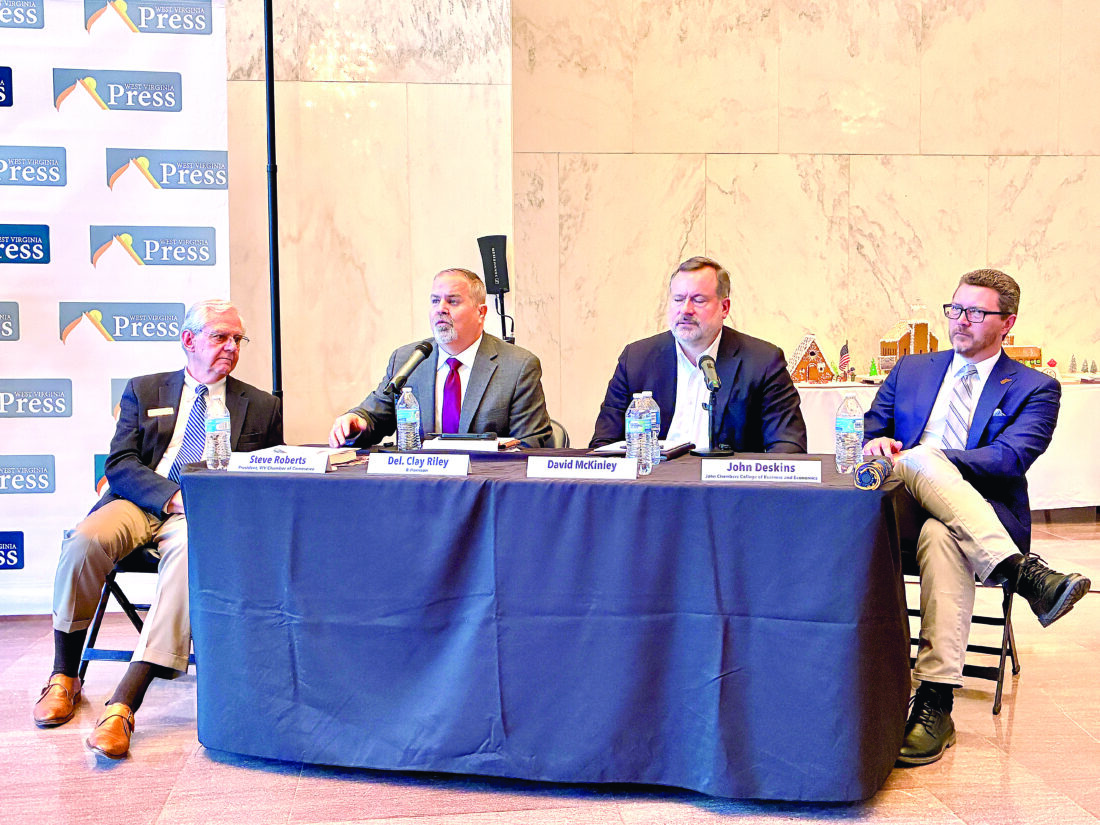
Steven Allen Adams BUILDING A FUTURE – Pictured from left are West Virginia Chamber of Commerce President Steve Roberts, House Finance Committee Vice Chairman Clay Riley, Wheeling businessman David McKinley, and WVU Bureau of Business and Economic Research Director John Deskins. They talked about West Virginia’s economic issues and bright spots Friday during a panel discussion at the West Virginia Press Association’s Legislative Lookahead.
CHARLESTON – Key leaders in economic development public policy held a robust discussion on improving West Virginia’s perceptions and addressing long-standing issues that have held the state back in areas of job growth and attracting new residents.
Reporters from around West Virginia gathered in Charleston on Friday for the West Virginia Press Association’s annual Legislative Lookahead at the Culture Center within eyesight of the golden dome of the State Capitol Building.
During Friday afternoon’s final panel, attendees heard from House Finance Committee Vice Chairman Clay Riley, R-Harrison, West Virginia Chamber of Commerce President Steve Roberts, Wheeling businessman David McKinley, and John Deskins, director of the Bureau of Business and Economic Research at West Virginia University, on the topic of “How do we move West Virginia forward?”
The panel acknowledged West Virginia’s significant, deeply-rooted challenges, including a low national ranking in per capita gross domestic product (GDP), a severe human capital crisis marked by poor education and health outcomes, and the nation’s highest rate of drug abuse.
“Our standard of living will improve, we will have more money for education and health care, and we will be able to create more economic opportunity if we find ways to move GDP up,” Roberts said.
After a period of job creation from 2015 to 2020, the COVID-19 pandemic caused a significant setback. According to the U.S. Bureau of Labor Statistics, West Virginia lost 1,400 jobs over the most recent 12-month period. The state’s workforce participation rate is the lowest in the United States, at approximately 54.8%.
“In a recent study (by the chamber), West Virginia is 48th in the nation for job growth over a 10-year period,” Roberts said. “Everything is not fixed.”
McKinley, the president of McKinley Carter Wealth Services and the owner of other businesses, said he travels to cities in nearby states, such as Ohio, Pennsylvania and Maryland and sees thriving economies just a quick drive from West Virginia.
“It pains me,” McKinley said. “How can we make a difference in West Virginia? How do we grow and diversify our economy? How do we create jobs that attract your home people? How do we realize the same potential that so many of our surrounding states have? It just is frustrating.”
Last year, McKinley founded the Mountaineer Freedom Alliance, a political action committee aimed at supporting lawmakers who champion policies to improve the economy instead of focusing on social issues.
“I formed a PAC, a political action committee,” McKinley said. “The effort is to try to educate and inform voters about how do we start to influence the legislative agenda, so-to-speak. It’s exciting.”
Deskins said there are regions in the state with momentum and exhibiting strong economic growth, such as the Eastern Panhandle and the I-79 corridor. These areas are identified as pockets of strength to build upon. In stark contrast, Deskins said many counties are not having the same momentum.
“We have just so many counties that have gotten caught up with this vicious cycle where they’re stagnant and cannot gain traction to get started and get the momentum,” Deskins said. “We just have too many of those counties.”
Riley agreed with his fellow panelists about the state’s challenges, but he said today was no time to be pessimistic about West Virginia’s future.
“You need to fix your expectations,” Riley said. “You need to expect that we are going to make West Virginia better and you’ve got to believe we’re going to make West Virginia better and we’re going to commit to make West Virginia better … I think of a flywheel, and it takes a while to spin up, but once it gets spinning and you continue to see that … you have to continue to try to do those things.”
The panel identified several foundational strengths the state can build upon to improve its economic conditions, including utilizing abundant energy and water resources, promoting the state’s strategic proximity to major U.S. markets, and promoting the state’s uniquely loyal workforce.
“West Virginia workers are statistically the most loyal workers in the nation,” Roberts said. “A company that hires a West Virginia employee is less likely to lose that employee than any other place in the nation.”
Deskins said West Virginia needs to do more to support and foster entrepreneurships, helping people start new businesses.
“We have to get strength across the board – healthy economies characterized by a strong, diverse industrial mix,” Deskins said. “The most important way, the most effective way to achieve that is through supporting entrepreneurships, through supporting entrepreneurs.
“If you support 1,000 entrepreneurs, a bunch of them are going to fail,” Deskins continued. “Of course, that’s the way entrepreneurship is, but the ones that succeed, the ones that take that chance, take that risk going a different direction. Those are the ones that will ultimately find the right industrial mix for West Virginia.”
Riley said attracting new businesses is important, but he also said that supporting the state’s existing business owners to grow and expand their businesses was also important.
“You have to be able to attract those new businesses, but … my dad always used to say, ‘don’t ever forget who brought you to the dance and who you went to dance with,'” Riley said. “Last year, we allocated $25 million annually to keep reinvesting in small businesses. Not just attracting new businesses, but reinvesting in small businesses, because they need help too. They’re already here.”
Roberts suggested a strategy of identifying what is already working well in the state – from successful manufacturers to perpetually booked state parks – and replicating those success stories across the state.
“Where I think we can do better is we could really pay attention to the people who know what they’re doing and have done well with something and ask them what they need in order to do more of that,” Roberts said. “I think what we need to do more of in West Virginia is go to the people who are succeeding here and ask them what they need in order to do more of what they’re doing.”
(Adams can be contacted at sadams@newsandsentinel.com)
Local News
Experts discuss changing perceptions of W.Va.’s economy to attract people, jobs
Hancock schools seek help to meet payroll
NEW CUMBERLAND – In the midst of ongoing reviews of its budget for the current and previous fiscal years, ...
Toronto woman on the road to Miss Ohio
TORONTO — It happened long before the bright lights of the Miss Ohio stage ever found her. It occurred years ...
Local GOP leaders support reopening primary in W.Va.
WHEELING – Ohio County Republican leaders say they support re-opening the GOP primary in time for the 2026 ...
Legislative Lookahead: House leaders focus on economic development, Senate’s focus unclear
CHARLESTON – House Speaker Roger Hanshaw emphasized an economic development plan supported by the Republican ...
Boil order issued for part of State Street
WEIRTON - A boil order has been issued for the 3600 block of State Street following work on a water line in the ...