
Bethany College founder focus of anniversary program
Trending
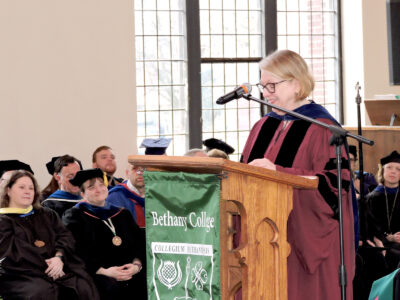
BETHANY -- The 186th anniversary of Bethany College's charter and the 160th anniversary of the death of its founder, Alexander Campbell, were marked with a special program Thursday reflecting on Campbell's nature and values.
As guest speaker for the college's annual Founder's Day Convocation, Kristine Culp, dean of the University of Chicago's Disciples Divinity House, a Christian seminary, noted poet Vachel Lindsay penned a tribute to Campbell in 1920.
In his poem, Lindsay called Campbell, a Scotland-born preacher and scholar known for his skill at debate, "a pillar of fire, the great high priest of the Spring."
Lindsay noted Campbell's love of nature and its connection to God, saying he stepped forth "to make the big woods his cathedrals, the river his baptismal font, the rolling clouds his bells, the storming skies his waterfalls, his pastures and his wells."
The poet said Campbell "preached with faultless logic, An American Millenium: The social order of a realist and farmer with every neighbor within stone and border."
Culp noted the influence of Campbell and Barton Stone, a Presbyterian minister in Kentucky, spread far in what became the Disciples of Christ Movement and the formation of thousands of Churches of Christ and Christian Churches in the U.S. and Canada.
She said in establishing Bethany College, Campbell's goal was to liberate students from the tyranny of superstition and prejudice and he "fought for education that was broad, vigorous and accessible."
Culp said Campbell's sources of inspiration included Paul's letter to the Galatians, in which the apostle advised early Christians to "Stand fast therefore in the liberty by which Christ has made us free, and do not be entangled again with a yoke of bondage."
The passage has been interpreted as direction to Christ's early followers to seek God's salvation through Christ and not from following the rules stressed by the Jewish rulers of his day.
Culp noted Campbell adopted the phrase, "In faith, unity. In opinion, liberty. In all things, charity."
It's been said that Campbell encouraged unity among Christians by focusing on core biblical doctrines while allowing freedom in non-essential interpretations -- with an overriding goal to follow Christ's directive "to love the Lord your God with all your heart, soul, mind and strength, and your neighbor as yourself."
Culp said there are "vulgar prejudices" in every era, producing hatred and fear, that must be overcome.
She said there must be a continuous effort to preserve freedoms and they can't be taken for granted.
Culp encouraged Bethany students in attendance, including many preparing for graduation in the near future, "to go on learning and interpreting and debating."
Bethany College President Jamie Caridi pondered what Campbell would say if he could be present to see the college today.
He said the great orator "might be speechless in seeing his vision has endured and its (the college's) courage to remain grounded in the values on which it was established."
The convocation also included the presentation of a new honor, the John U. Davis and Marianne S. Davis Educational Advancement Award, to Kayce Mobley, chair of the college's political science and history department.
Scott Thompson, a 1978 alumnus and co-director of the Beta Theta Pi Charitable Foundation, explained the award was established to honor John -- a long-time Bethany education professor and active member of the national fraternity -- and his wife, Marianne, a 20-year teacher at Bethany Primary School who also worked at the college.
Thompson said the award will be presented annually to an outstanding professor with $3,000 for initiatives that support professional development and the college's growth.