
Compromise House, Senate budget bill includes 5% cut in personal income tax rates
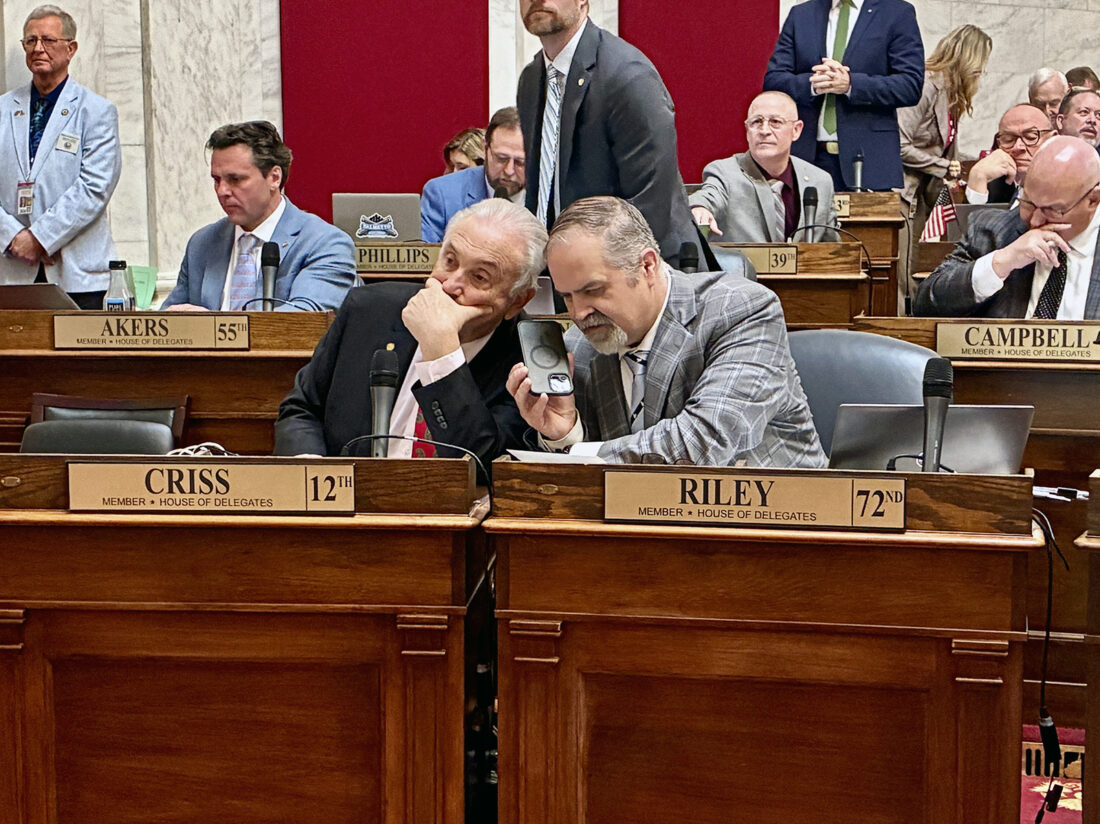
House of Delegates Finance Committee Chairman Vernon Criss, left, and Vice Chairman Clay Riley listen to a livestream of the state Senate’s floor session through a phone on the House floor Thursday as the Senate amended and passed a compromise version of Senate Bill 250, the budget bill. -- Steven Allen Adams
CHARLESTON — In one of the earliest times in modern history, the West Virginia Legislature has completed work on the general revenue budget for fiscal year 2027 with more than a week left in the legislative session, agreeing to half of the personal income tax cut that Gov. Patrick Morrisey wanted.
The House of Delegates and the state Senate agreed to a compromise Thursday on Senate Bill 250, the budget bill handed to lawmakers on the first day of the 2026 legislative session by Morrisey during his second State of the State address.
The compromise sets the general revenue budget for fiscal year 2027 beginning on July 1 at $5.485 billion, a 0.4 percent increase from the $5.463 billion amount approved by the House last week, a 1.9 percent increase from the Senate’s version, but a 0.2 percent decrease from the governor’s $5.493 billion revenue estimate. The compromise budget leaves $5 million unappropriated.
The Senate amended and passed SB 250 Thursday morning in a 30-1 vote with one absent or not voting. The House of Delegates voted 68-15 with 16 absent or not voting Thursday evening for the compromise bill, sending it to Morrisey’s desk.
Senate Finance Committee Chairman Jason Barrett, R-Berkeley, said it was important to begin the budget process earlier.
“For the Senate to be able to put ourselves in a position that delivers as much as we want in the budget, it was important to have these discussions early and move a little quicker than the moment,” Barrett said.
“I think it is responsible,” said House Finance Committee Chairman Vernon Criss, R-Wood, when explaining SB 250 on the floor Thursday night. “It’s part of the process. …In a compromise, not everyone gets what they want. You have to settle for things and try in your best knowledge at the time to be able to authorize the spending of these dollars in various ways.
“It is difficult to do,” he continued. “We obviously make mistakes. That’s why we come back the following year and talk about supplemental appropriations so we can fix some of the problems.”
The Senate and House agreed to cut personal income tax rates by 5 percent, which was included in the governor’s version of the budget. The proposed cut would be retroactive to Jan. 1 and return $125 million to taxpayers when fully implemented.
Morrisey has been asking the Legislature to consider an additional 5 percent cut to personal income tax rates and for a total reduction of 10 percent. He made that appeal again at a Wednesday press conference in Beckley.
“I can’t imagine any better way to deal with the affordability challenges that everyday West Virginians face than an across-the-board income tax cut,” Morrisey said. “I have great confidence that we’re going to be able to pull this off. … West Virginians cannot afford for the Legislature to fail, can they? They can’t, no way.”
The House Finance Committee will need to amend and pass Senate Bill 392, Morrisey’s tax cut bill, and reduce the cut from 10 percent to 5 percent. The committee held a hearing on SB 392 Tuesday.
Barrett said the Senate supported the full 10 percent personal income tax cut in SB 392, including a $22 million revenue offset in the form of increased vape and e-cigarette taxes to partially pay for it.
“I think a lot of folks believe that we would settle at 5 percent,” Barrett said. “We were in line with the governor on the 10 percent cut. I just don’t believe the House had an appetite to go that far. I don’t want to put words in their mouths, and I don’t want to speak for them, but it appears through this compromise that they were willing to get to 5 percent, and they have that bill over there.”
“According to what the governor has given us on his initial tax program, he reduced the revenue estimates by 5 percent so we can expire a 5 percent cut in personal income tax rate,” Criss said.
The budget includes several of the governor’s priorities, including the average 3 percent pay raise for teachers, school service personnel, State Police employees and public employees paid through the general revenue budget ($78.4 million); and the Statewide Interoperable Radio Network ($2.6 million). The budget also includes a $40 million increase over current funding levels for adoption and foster care services.
The House version of SB 250 restored the 2 percent cuts made to higher education institutions in the governor’s introduced budget, the compromise budget restores those 2 percent cuts. But the higher education funding formula remains fully funded for the first time since implemented a few years ago.
The compromise includes several of the Senate’s positions, such as the creation of an Office of Entrepreneurship within the Secretary of State’s Office, as well as additional funding for the School Building Authority, pregnancy centers and court-appointed special advocates.
House items that remain in the budget include an extra $1 million for guaranteed workforce development, $500,000 in additional funding for Marshall University and West Virginia University grant-writing collaboration, $1 million for establishing international trade offices and $1 million for the Jobs for West Virginia Graduates program.
The Hope Scholarship educational voucher program is funded in the compromise budget at $297 million. This includes $117 million provided through the FY27 general revenue budget, $20 million in carryover funds already available through the State Treasurer’s Office, $100 million in supplemental appropriations and $60 million to be paid out from available surplus tax collections at the end of the current fiscal year on June 30.
The Hope Scholarship gives parents the option to use an equivalent portion of the per-pupil expenditure for their children from the state School Aid Formula – $5,436 for the 2026-27 school year – for educational expenses such as private or religious school tuition, home school, tutoring and learning aids.
The Hope Scholarship program opens to all eligible public, private and home school students in FY27, with the application period beginning earlier this week. The State Treasurer’s Office, which manages the program, estimated it would cost $230 million for FY27.
The $297 million amount will fund five quarters of payments covering all of the upcoming 2026-27 school year and the first quarter of 2027-28 school year, eliminating the need for future supplemental appropriations and expenditures from the surplus section of the budget.
“Moving forward, the idea is, every year, we just come back and put one year’s worth of Hope scholarship money in the budget, and we never have to do a supplemental again, and we never have to use a surplus section to fully fund Hope,” Barrett said.
The compromise budget also includes an additional $28 million for Medicaid over current fiscal year appropriations, bringing funding to $284 million. Funding for the aged and disabled waiver programs increased by $5 million over the current fiscal year, to $162.6 million. Another $29 million will be sent to the Personal Income Tax Reduction Fund, bringing it to more than $522 million.
The surplus section in the back of the compromise budget includes $245.4 million in appropriations, with the $60 million Hope Scholarship appropriation at the top of the list. Items in the surplus section are paid out in the order they appear based on how much surplus is available at the end of the fiscal year.
Other surplus appropriations include; $250,000 for the Lily’s Place substance use treatment program in Cabell County, $100,000 for the Willow Bend Agricultural Innovation Center in Monroe County, $5 million for Glenville State University, $30 million for the West Virginia Infrastructure and Jobs Development Council, $10 million for the Abandoned and Dilapidated Property Program Fund, $125 million for road and bridge maintenance, $10 million for the Neighborhood Access Road Fund and $5 million for the Flood Resiliency Office Trust Fund.
Getting the budget done with nine days to go in the 60-day legislative session sends it to Morrisey’s desk in time to override any line item vetoes the governor may make. A governor has five days to sign a bill, veto a bill or do line-item vetoes while the Legislature is in session once he receives it. If the governor takes no action after five days, the bill becomes law without his signature.
While the Legislative can override a governor’s veto on other bills with a simple majority, it takes a two-thirds majority vote of the House and the Senate to override vetoes of the budget bill, supplemental appropriations and line-item vetoes of specific budget items.
Speaking following Thursday evening’s floor session, Criss said the Senate should have SB 250 to the governor’s desk by Friday.
“We wanted a budget out so that we have the opportunity for the governor to take a look at it,” Criss said. “And if he decides to do line item vetoes then we have the opportunity to override those vetoes.”
Democratic members in the House and Senate voted against SB 250, upset about the timing of the compromise, lack of minority party input and the lack or reduction of Democratic priorities, such as reducing the dollar amount in a successful amendment offered by the minority to reduce $25 million for the Flood Resiliency Office Trust Fund to $5 million.
“There are a few good things about this budget. … Unfortunately, the bad things are more numerous,” said Senate Minority Leader Mike Woelfel, D-Cabell, and Senate Assistant Minority Leader Joey Garcia, D-Marion, in a joint statement Thursday.
“Our priorities were not reflected in this budget. … Unfortunately, the Senate did not prioritize those values,” the joint statement continued. “They prioritized funding the HOPE scholarship and a 5 percent tax break that will go mostly to the wealthy donor class, while failing to increase any funding for public education.”
Speaking on the House floor Thursday evening, House Finance Committee Minority Chairman John Williams, D-Monongalia, said SB 250 doesn’t do enough to meet the needs of West Virginians and doesn’t invest in services.
“I’m concerned still with our state budget,” he said. “I’m concerned that our services continue to suffer from attrition because of inflation. I know that the taxpayer expects us and deserves from us that we be good stewards with their dollars. I also think the taxpayer expects the State of West Virginia to take care of basic needs with which they’ve become accustomed to having taken care of.”
Local News
Bethany College founder focus of anniversary program
Compromise House, Senate budget bill includes 5% cut in personal income tax rates
Hearing set on Weirton Municipal Service Fee increase
WEIRTON — Weirton Council is set to vote on the second reading of an ordinance which, if enacted, would increase ...
House narrowly rejects Iran war powers resolution in test of Trump’s strategy
Weirton Council set to consider 26-27 fiscal budgets
Alleged Weirton tire slasher among grand jury indictments in Brooke County
WELLSBURG — A Weirton man who allegedly forced his way into a neighbor’s home while bearing a knife was among ...