
Grant to bring WSX Bulletins on line
Trending
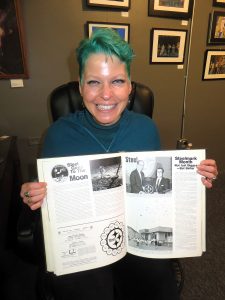
WEIRTON -- The Weirton Steel Employees Bulletin Archives -- more than 10,000 pages of historical images and information from the mid-1930s to the late 1980s -- are set to go online this year, thanks in part to a grant awarded to the Weirton Area Museum and Cultural Center at 3149 Main St.
And that gesture elevates the museum to a research center with such information available 24-7 to a global audience.
The grant comes from the West Virginia Humanities Council and the National Endowment for the Humanities, according to Savannah Schroll Guz, the center's executive director.
“We are so grateful for this support, which will allow us to make the Weirton Area Museum and Cultural Center a research center as well as a preservation center for physical artifacts,” Schroll Guz said. "It is our first step in creating a digital library of online research tools that scholars, genealogists, high school and college students and other academicians can use to learn more about our region and its role in shaping American history.”
The investment and efforts of Executive Director Emeritus Dennis Jones also make such a project possible, Schroll Guz pointed out, explaining that Jones spent his own money in 2017 to have a company digitize and watermark every Weirton Steel Employees Bulletin, from its first issue in April 1934 through its final issue in December 1989.
These digitized files currently are offered on a computer terminal on the museum’s second floor.
Schroll Guz emphasized how significant the Weirton Steel Employees Bulletin Archive is.
"The information contained in these bulletins is a record of the economic, social and war-time history of the thousands of Weirton Steel employees -- male and female -- from West Virginia’s Northern Panhandle and the surrounding Tri-State Area," she noted.
"To bring this information to a worldwide audience through an online platform is part of raising the profile of West Virginia’s rich industrial and social history and part of our museum’s mission to 'preserve our history and culture for future generations.'"
The museum will host a livestream event introducing the new digital archive to the public when it's ready.
"If we're able to have people, there will be an in-person event where we will do a demo of how to use the web interface so people can become more comfortable with its use," Schroll Guz said. "It will definitely happen in 2021 and probably before October, my guestimation."
On the museum Facebook page, a Jan. 1 post noted the Bulletin would be celebrating an 87th birthday.
"In the January 1949 issue, the Bulletin celebrated its 15th birthday by including some statistics," the post reads. "In 1949, the Bulletin had a circulation of 25,500, with 50 voluntary reporters. Perhaps most surprising is that the Bulletin's readership would have filled the Rose Bowl Stadium in Pasadena, Calif., to its capacity 150 times over." In its initial 15 years, the Bulletin used 6,250 miles of paper, according to the post.
Schroll Guz is excited at the prospect of the archives going online and the information being made available because of it.
"We (Weirton) were a force in the Ohio Valley, in the state, and to have all that information about our activity in wartime, what we were able to accomplish, the fact that we earned Army-Navy excellence awards in production, all that information is in there, but there are decades of information that tell people about us," she said.
"And I think there's not enough information out there about us as a city and what we have done historically so getting it onto the web makes it available internationally 24-7," she added.
Before moving to Weirton in early 2000, Schroll Guz had worked at Smithsonian Institution Libraries as their public information officer.
"They had a tremendous digital library and that was the goal -- to make some of those rare books available to international scholars, academicians and genealogists so those kinds of things are part of my long-range goal for the museum where we can become a center for research because we have the largest collection of Weirton Steel, not just the Bulletins, but Weirton Steel archival material," she said.
"We really need to hire an archivist to go through all those because they're in storage, they need to be gone through, and I have some training in that, but there are people who specialize in archival work," she said of a goal she has "to get that sorted, organized and online so we can start creating a research center here because we have this amazing story that doesn't get told frequently enough or widely enough."
The grant from the West Virginia Humanities Council and the National Endowment for the Humanities is one of eight awarded in the state.
"It was only $1,500, it's a mini grant, and then we have to match it, so we're fundraising," Schroll said. The total project is near $3,000.
Advantage Preservation in Cedar Rapids, Iowa, has submitted a bid for the project, but Schroll Guz hopes there's a West Virginia business that might be interested.
"We want to try to keep our money inside the state of West Virginia, so I'm also looking for another company that may be able to offer us the same services in state," she said, "but right now we have a bid from the Cedar Rapids company, and they are going to create an extension to our website so that it's accessible to the public."