Wintersville to celebrate 200 years of Methodism
Church to combine event with 1926 bell re-dedication
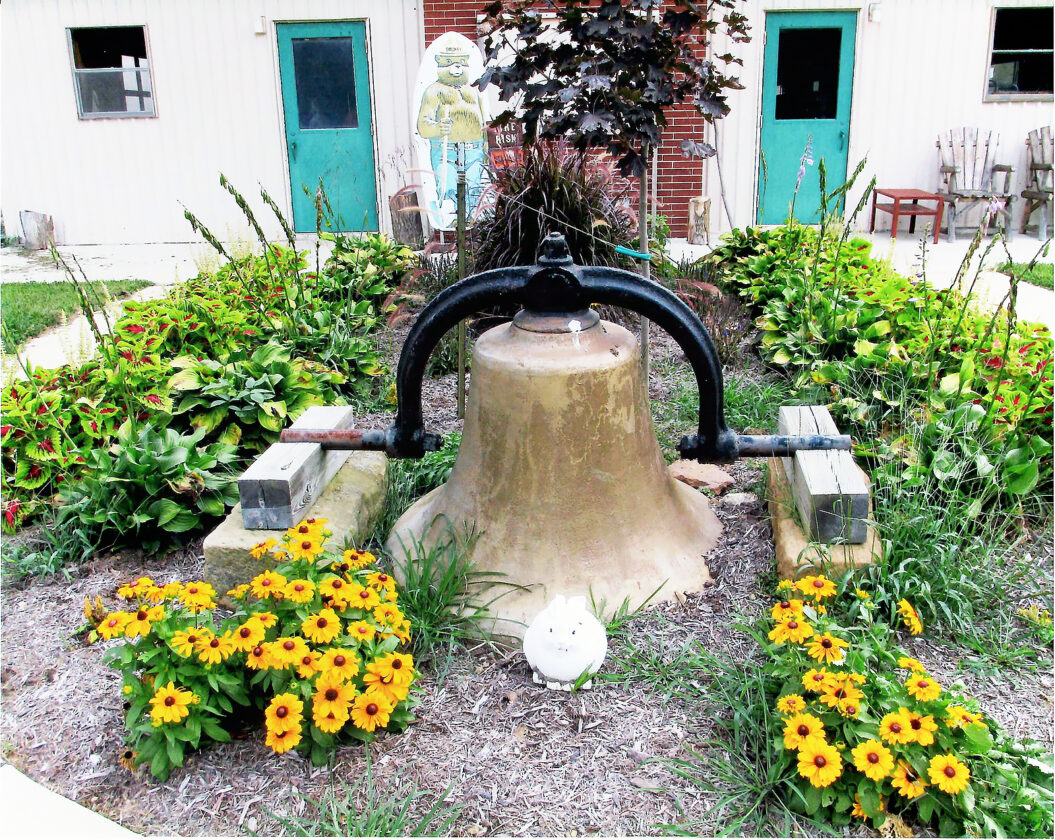
TO BE REDEDICATED — This 1926 church bell, located at the Boy Scout Camp Scout Reservation in Clendenning, Ohio, was regained by the church and will be re-dedicated during a special service. The bell has been completely redone and will look similar to how it appeared in 1926, with some added enhancements. -- Contributed
-
- TO BE REDEDICATED — This 1926 church bell, located at the Boy Scout Camp Scout Reservation in Clendenning, Ohio, was regained by the church and will be re-dedicated during a special service. The bell has been completely redone and will look similar to how it appeared in 1926, with some added enhancements. — Contributed
-
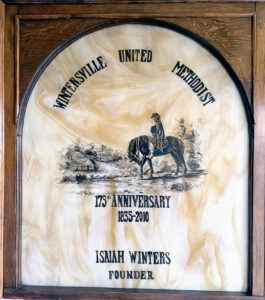
- A circuit-riding pastor went throughout the region to attend meetings in which services were held inside peoples’ homes. The portrait hangs in the Wintersville Methodist Church. — Contributed
-
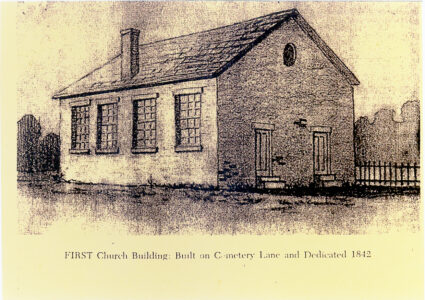
- CELEBRATING 200 YEARS IN WINTERSVILLE CHURCH — The first church constructed in the village of Wintersville is displayed on the right. The structure was erected on Cemetery Lane. — Contributed
-
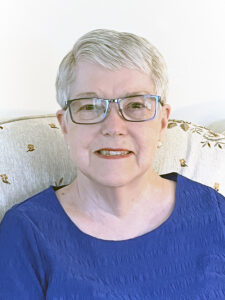
- DAY AUTHORS BOOK — Historian Sandy Day has researched the history of Wintersville Methodist Church for years. The records and findings she has uncovered have been placed into a book containing church history. Books are autographed and available at the church office for $20. — Contributed
It is quite a milestone to celebrate, especially for area churches that have withstood the test of time.
Several places of worship in the Ohio Valley have closed their doors throughout the years, while others have continued to remain a sound presence within their communities.
The Wintersville Methodist Church is one of those churches.
Historian Sandy Day recently announced her church is recognizing its 200th year of Methodism in the village of Wintersville. What’s more, the church has regained possession of its original bell and will be rededicating it as part of an upcoming program celebrating both events.
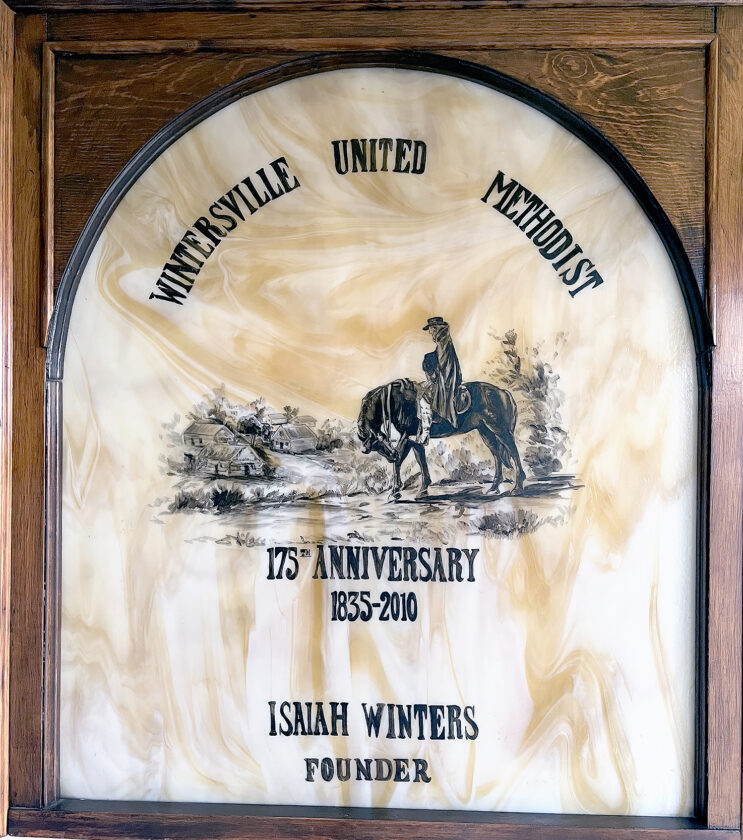
A circuit-riding pastor went throughout the region to attend meetings in which services were held inside peoples’ homes. The portrait hangs in the Wintersville Methodist Church. -- Contributed
Day compiled the church’s history book for its 180th anniversary. She decided to pen the compilation of its history since she was referencing facts for future generations.
But she had some digging to do.
“I found many resources that stated Methodist meetings were held ‘sometime before 1828,'” she began. “For a historian, this is a non-date.”
So, she began that researching.
“In 2015, the church history room was in the balcony,” Day exclaimed. “I went there many times seeking as much historical data that I could find. I finally found a record stating class meetings were held in this village as early as 1824.”
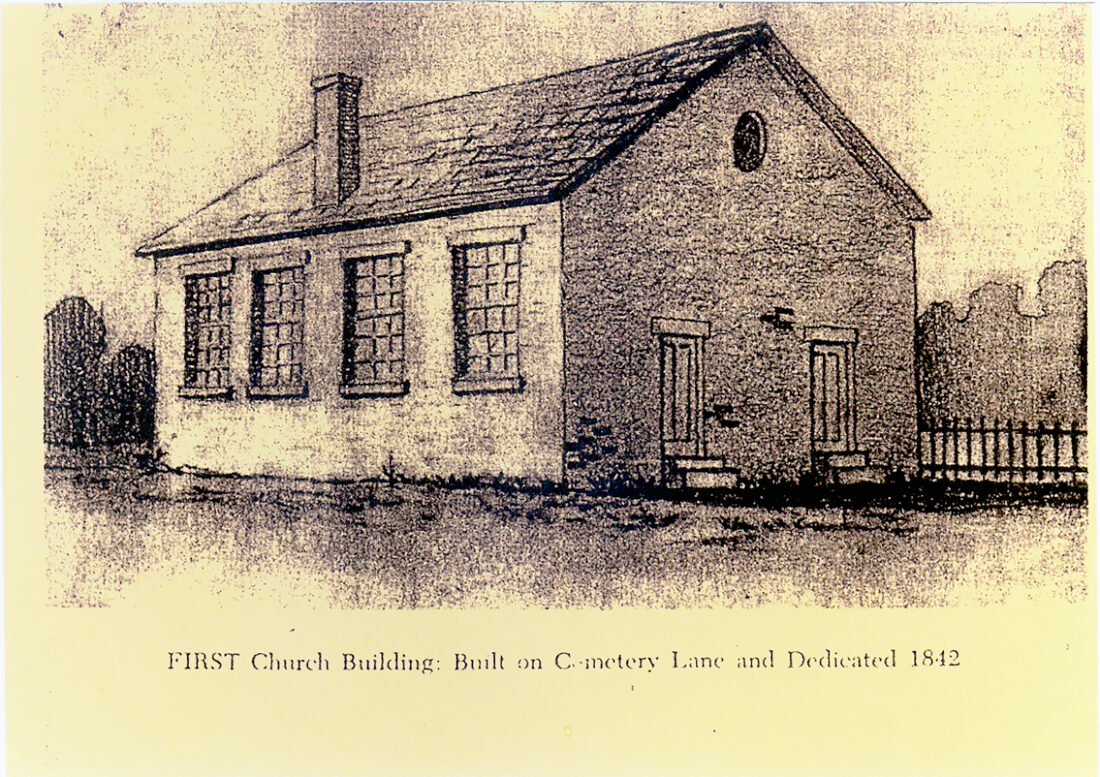
CELEBRATING 200 YEARS IN WINTERSVILLE CHURCH — The first church constructed in the village of Wintersville is displayed on the right. The structure was erected on Cemetery Lane. -- Contributed
1824.
A much different time in comparison of today.
Wintersville was not yet Wintersville.
Many homes were still using logs as the choice of building materials.
No one had even thought of the concept of a motor vehicle. Dirt roads were meant for horses as the means of travel.
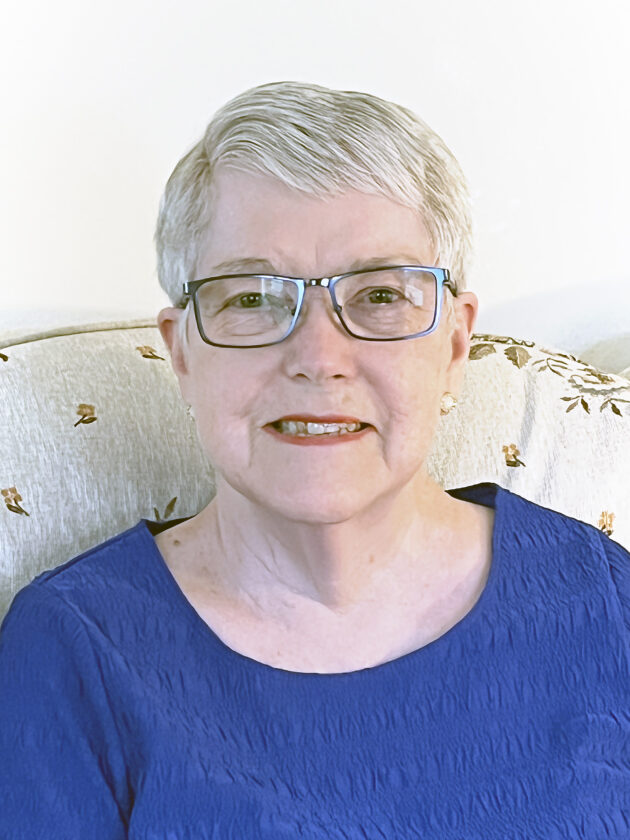
DAY AUTHORS BOOK — Historian Sandy Day has researched the history of Wintersville Methodist Church for years. The records and findings she has uncovered have been placed into a book containing church history. Books are autographed and available at the church office for $20. -- Contributed
The one thing which has remained the same, however, is a faith in God.
The very first Methodist class meeting in Wintersville was not held inside a spacious church.
There was no domed or vaulted ceiling to draw attention to the heavens.
There were no large crosses or crucifixes hanging on the walls.
No statues of saints.
No stained glass or tabernacle choirs singing in a loft.
The first gathering for a meeting of Methodists in Wintersville took place inside one of those small, log homes.
That structure was located one mile west of what would later come to be known as Wintersville.
The home belonged to Isaiah Winters and his wife, Catherine, according to records discovered by Day.
Although meetings were held in other log homes, Winters held the first, hosting meeting members Robert and Fanny Morton, Mr. and Mrs. Richard Coulter, Mr. and Mrs. Thomas Porter, Mr. and Mrs. William Nixon, Mrs. Adams and Mrs. Clark Hall, records indicated.
Leading the meetings was a circuit-riding preacher who would visit various areas of the region, preaching the gospel to those who were interested in listening, Day said.
“These preachers came on horseback and traveled many miles on their circuit,” she stated. “A record was found stating they met in Isaiah’s home for about five years. Another record was found stating his log home was located on Steubenville-Richmond Road. The name of that road today is state Route 43.”
It is believed that Isaiah Winters and his brother, Isaac, settled in the area prior to 1800. An exact year has not been located, Day noted.
“It is also believed that Isaiah’s log home was located in what is now Sunset Gardens,” she added. “This is where (my husband) Greg and I have lived for more than 45 years.”
Day stated she has a friend who informed her she lived in the subdivision on Garden Drive when she was a child — more than 60 years ago. She reflected upon how her friend remembered seeing an old log house not too far from her home.
“This could very well have been Isaac Winters log home,” Day commented. Although she has no physical way of proving it, she added.
The services that were held in the Winters’ home usually took place on a Friday evening. It is not known exactly how many people were in attendance, but the gatherings were referred to as class meetings.
“Think about this for a moment … these log homes were certainly not huge, but these early settlers in our village found a way to serve the Lord,” Day exclaimed.
“Most of the people either walked to these meetings or rode on horses — sometimes more than one person on a horse,” she stated.
Day mentioned a news story was found from the Western Herald newspaper, dated Feb. 9, 1831. The article read how Isaiah Winters’ son, John, was in possession of town lots for sale.
“There were 40 lots in what is now known as the village of Wintersville,” she noted, saying these town lots were located on both sides of the road that had been known as Steubenville Street.
That road today, is called Frank P. Layman Boulevard, after the mayor who was instrumental in widening the main street in the village many years ago, Day cited.
A man by the name of William Roberts erected a small, brick church on the site where the Wintersville Historic Cemetery is located.
Roberts chose this particular location because he did not want his wife to have to walk too far to attend meetings. This small, religious structure would become the first permanent home of the Wintersville Methodist Episcopal Church, Day discovered.
Day conveyed that by the year 1835, these class meetings had been formally organized into a church, becoming part of the Richmond circuit.
That year, the Wintersville Methodist Church was officially established.
The village of Wintersville’s population in 1840 was 107 people, according to a census record, Day stated. According to a 2020 federal census, there were 3,609 residents in the village.
“To become a city, the requirement is that there have to be 5,000 residents,” she said. “This has never happened in our village.”
“I compiled a history of this church to celebrate the 180th anniversary of this church,” Day explained.
“The church history provides great details on its complete history. The book details the early members of those class meetings,” she continued. “The history book provides the complete history of the church, including the donation of the Pierce/Connelly property to this church in 2015. That property was purchased to supply more space for the Center for Hope, when it was built.”
The Center for Hope was dedicated in March 2020 — prior to the world learning about the COVID pandemic.
Day discussed the history book, saying there are readings from the Historic Methodist Cemetery on Woodridge Drive, formerly known as Cemetery Lane.
The readings are of those who were members of the early church and the ones who are buried in the cemetery.
In the front of the church sanctuary there is a painting of a circuit-riding preacher — just like the one who visited Isaiah Winters home for class meetings.
The painting was performed by a local artist in order to celebrate 175 years of Methodism in the village of Wintersville, Day said, adding church member Shirley Beck is the person who coordinated that project.
Current church members who are descendants of the early members of the church include Leland McConnell, whose ancestors were Henry Oliver and Caroline Crawford Roberts; and David Price, who is a descendant of John and Catherine Winters Floyd.
“Dave and Leland’s families were very early members of the first church,” Day exclaimed.
A program will take place later this month, Day commented. The event will feature the celebration of 200 years of Methodism in the village and will focus on the re-dedication of the 1926 historic bell.
“The church where we are now standing beside was dedicated on Easter Sunday, on April 4, 1926,” Day stated. “Miss Emma Floyd donated the funds for the bell. She actually rang the bell the first time it was used.”
“This is the third edifice that is now known as the Wintersville Methodist Church,” Day said.
According to the church history that she wrote in 2015, the Wintersville Methodist Church was the name of the building from as far back as 1835.
As for the bell, it was in February of 1969 that the church added a carillon.
A carillon is a keyboard instrument such as an organ or pedal piano that consists of a minimum of 23 bells.
The pitched percussion instrument took the place of the bell, which was no longer used.
It was then that the church bell was removed. Church officials decided to donate the bell to Fort Steuben Council Boy Scout Reservation at Clendenning Lake in Harrison County.
Jim Rose, who serves as properties chair for the Boy Scout Council, said the bell, for many years, was used by Boy Scouts and leaders to announce when it was time to come to the dining hall and eat.
However, in recent years, the bell was no longer being used at the camp. Because it was not being used, talks began and ran throughout 2023.
Church member Bob Woods went to see the bell at the reservation.
He informed Day and her husband that they should try to get the bell moved back to its original home in Wintersville.
So, the Days went to see the bell and get its dimensions. And Rose sent a letter to the Rev. Clint Quillen, the church’s pastor, regarding the bell.
Rose stated in writing that the Ohio River Valley Council Boy Scouts of America and Fort Steuben Scout Reservation had been the bell’s caretakers for 56 years.
He wrote the church would need to pay any costs associated with moving the bell and restoring it.
It took several months, Day explained.
But finally, they were able to regain possession of one of the first pieces of the current church building.
Day noted Cline’s Powder Coating in Toronto refinished the bell.
That letter which Rose sent to the church will be kept in a three-ring binder in the church history room for future members to know what today’s church members have done to make the bell become a reality once again.
“Thank you for being here to help celebrate 200 years of Methodism in Wintersville,” Day concluded.
She expressed her gratitude to those who were and who are continuing to remain faithful to the Wintersville Methodist Church throughout the past two centuries.
Autographed copies of the church history are available for purchase to anyone who would be interested in learning more. The cost is $20.
Autographed copies are available in the church office, Day announced.
(Day contributed most of the information in this article, based on her thorough research throughout the years.)
Local News
Delays expected on South 11th Tuesday because of paving
WEIRTON – Traffic delays are expected on a portion of South 11th Street, Tuesday, as a result of scheduled ...
Jefferson County Health District alarmed by increase in fatal drug overdoses
STEUBENVILLE — Jefferson County officials are sounding the alarm about an uptick in fatal drug overdoses. Health ...
Serving a lesson
Wintersville marks Day of Prayer
Steel Valley Showroom expands Cedar One’s reach beyond real estate