
St. Mark’s 100th anniversary
Church plans events to mark a century of service to Steubenville area
Trending
STEUBENVILLE -- St. Mark Lutheran Church, located at 133 Lovers Lane, will celebrate its 100th anniversary Sunday. The theme is entitled "Walking by Faith not by Sight."
An anniversary worship service with holy communion will take place at 1 p.m., followed by a celebration dinner where past members will celebrate the special day with the congregation.
Following dinner, a short musical program featuring Mark Statler and vocals by Brooke Ferrell and Chelsea Householder will take place. Officiant will be the Rev. Scott A. Kuntz and Millard Neal will serve as organist.
The church will honor past and present members for their contributions to the church and will name charities St. Mark has contributed to and still supports financially and with gifts of food. There will be displays and pictures of past and present pastors, as well as past and present members who participated in community events.
Officials will be welcoming representatives from local charities which St. Mark has supported and hopes to continue supporting for the next 100 years.
So how did it come to be?
How did the St. Mark Church come into existence 100 years ago?
A cluster of Slovak immigrants came to live in the South End of Steubenville, working in the local steel industry.
The farmers and miners of Slovak descent settled in the outskirts of Avella, Central City and Wolf Run, stated Kuntz.
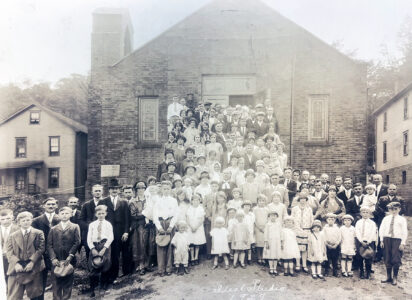
Thirty-four individuals who lived by faith got together, organized and founded St. John the Baptist Lutheran Church on Aug. 6, 1923.
One-hundred people gathered from the surrounding areas and started holding services in Swartz Hall or Lincoln School -- whichever was convenient for use on that Sunday.
Representation from Steubenville was 26 people; Mingo Junction, 10; Colliers, 15, Weirton, 21; and Plum Run, 16, it was noted.
Kuntz explained 21 months later, on Oct. 17, 1926, a dedication ceremony was held for the new church building.
The church was mostly built by parishioners on Lincoln Avenue.
The first pastor was the Rev. Frank Manka, who served from 1923-28, beginning the 100-year journey.
The Revs. Adam Valencik and George Kozelonisk collectively served six years; the Rev. Frank Machina, six years; and Samuel Mozolak five years.
"The church grew and celebrated marriages, baptisms, confirmations, funerals and special holidays," Kuntz stated. "Services were held in English and Slovak. Sunday school and choirs were established. A senior ladies aid was formed. They gave their proceeds from their nut roll-making to the church."
"In 1937, a great flood hit the Ohio Valley, including the low-lying south Steubenville. Flood waters reached the sanctuary of St. John and ruined the organ. Church member John Shernit repaired that organ.
It was played by many organists through the years. Sue Shernit was the first, followed by Susan Majeros Bruno, Mildred Brondos Hawkins, a 13-year-old who couldn't reach the pedals; Linda Brondos Meloy, Margaret Shernit Patton, Polly Shernisky White, Carol Brondos Hicks, Dan Bruno, Jan DiCarlo, Tekla Robinson and then music students from Franciscan University of Steubenville," Kuntz continued.
The Rev. John Kucera pastored from 1949-59. During his tenure and leadership, the church grew.
Sometimes even chairs were added to the aisles to accommodate the overflow, he said.
"With the church leaders, Kucera initiated a building fund for a future building for worship," Kuntz recalled. "Confusion arose within the city with two churches named St. John and as a result, St. John the Baptist changed its name to St. Mark in 1955."
"Kucera received and accepted a call to St. Peter and Paul in Lakewood," he added.
"The Rev. John Horarik stepped in as the next pastor from 1960-62. A site of property was chosen in 1956 on 133 Lovers Lane," Kuntz said.
"Horarik, along with members John Brondos, Ed Bruno, John Gulas, John Janosov and Michael Mihalo blessed the site. Seven churches would eventually be built on Lovers Lane," Kuntz said.
The Rev. Milan Babel, served from 1963-69.
The cornerstone for the current building was laid in 1963. "At the time, Andrew Shernisky was church president and Paul Hawkins led the construction project," Kuntz noted.
During Babel's shepherding transient members joined St. Mark and were welcomed.
They shared their talents and presence with the congregation. The church was blessed to have them. Babel was the last preacher to preach in Slovak.
"The dedication of the new church building came in 1966," Kuntz stated. "The interior furnishings, such as pews, altar, pulpit, organ and candles, were donated as gifts and memorials by various church members. Later, a stained-glass window designed by Donald Smerick was installed in memory of John Brondos."
The sister congregation in Wolf Run held its last service, joining St. Mark in 1964.
The altar was given as a gift and refurbished by Dr. James Bull and his son, Justin, an Eagle Scout. This altar is currently in use in the fellowship hall today, in use when divine services are held downstairs," Kuntz continued.
The Rev. Joseph Molitoris, who served from 1970-77, guided the church through the 50th-anniversary service in 1973. The Rev. Kenneth Reed followed from 1977-86, celebrating the 60th-anniversary celebration in 1983.
"Due to dropped enrollment at the seminaries, the church as a whole experienced dry periods without called pastors to fill the pulpit," Kuntz said.
"The call committees of St. Mark, however, were busy," he added.
"In 1987, the Rev. Chris Olgstad served until 1989. He was followed by the Rev. Kenneth Greenwald from 1990-2004.
"With pastors not being plentiful, the Lutheran Church Missouri Synod implemented an internship with seminary students to serve as vicars 2 to St. Mark," Kuntz said.
"In 2006, under the supervision and mentorship of the Rev. John Telloni of Massillon, David Oster served, followed by David Abuya, John Rutz, Steve Hoerr, Brian Rosenketter and Eric Rapp," he stated. All served one year each.
During the absence of pastors, retired ministers were sent to fill in, including Robert Matij, Donald Hayes and Ed Kucera.
David McCloskey was a church member who enrolled in Concordia Seminary in St. Louis.
The congregation supported him and his family while he studied there.
He was called back to St. Mark upon his ordination in 2013. He served until 2021.
To continue the word and sacrament ministry, Kuntz has been serving since November 2021.
Kuntz stated, "During the decades of the 70s, 80s and 90s, the children continued for higher education and skills.
"Sadly, they had to leave the area for job opportunities elsewhere. We pray that the seeds of the word planted in their youth compels them to seek the Lutheran faith where they are, and feel welcomed here always."
"Our outreach programs throughout the years were abundant in supporting local charities," according to Kuntz.
"The outreach programs took part in distributing New Testaments in the neighborhood, cleaning Fort Steuben, food baskets, food pantry, correctional ministry, Urban Mission, assisting the work of the Salvation Army and Red Cross, just to name a few," Kuntz commented.
The outreach most fondly remembered is the nut roll project.
It was started in 2002 by Becky and John Hersko, using Pauline Budai's recipe from 1930.
The gifted bakers made nut, fruit and poppy seed rolls which were sold to the public, including the farmers market in Steubenville.
The proceeds were all donated to charities and the church ministries, he explained.
"Another strong arm of the church is the Lutheran Women's Missionary League 3," Kuntz concluded.
"The women were energized with the word and the spirit while attending retreats and conventions, locally and nationally.
"Mite boxes are still collected each month for local, state and national mission projects. This summer, the LWML voted at the Milwaukee convention to set a goal of raising $2,350,000 for mission projects, including worldwide mission projects."
"Sadly, present membership has dwindled in numbers, but not in spirit for the Lord," Kuntz noted.
"It is a very difficult time for all churches in this blessed country," he said.
"The COVID pandemic added to the decline in 2020."